Detailed Explanation of Ginger and Corn Intercropping Cultivation Techniques
Ginger is a shade-tolerant crop, and high temperatures and strong light are unfavorable for its growth. Intercropping tall-stalk crops in a ginger field can make full use of the three-dimensional space of tall and short crops, provide shade for ginger, improve light energy utilization, and also improve land utilization, increasing yield per unit area. It does not affect the yield and quality of ginger, and can also...
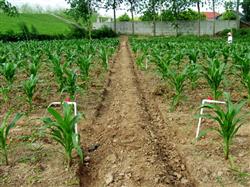
Ginger is a shade-tolerant crop, and high temperatures and strong light are unfavorable for its growth. Intercropping tall-stalk crops in a ginger field can make full use of the three-dimensional space of tall and short crops, provide shade for ginger, improve light energy utilization, and also improve land utilization, increasing yield per unit area. It does not affect the yield and quality of ginger, and can also increase farmers' income. It is a simple and easy cultivation method. The specific cultivation techniques are as follows:
1. Land selection
Choose loam soil that is loose, fertile, rich in organic matter, and well-drained, and choose fields where the previous crop was not a Solanaceae crop and with more than 3 years of crop rotation.
2. Variety selection
For ginger, choose local high-quality, high-yield varieties
For corn, choose high-quality hybrid varieties commonly planted by farmers
3. Cultivation method
Ginger sowing time is generally late February to early March. When planting, apply 3000 kg of farmyard manure and 50 kg of compound fertilizer per mu. After ginger sowing is completed, intercrop corn in early May when the soil is moist. Corn intercropping adopts east-west line cultivation, with a row spacing of 1.8-2 m and a plant spacing of 30 cm, dibbling, leaving 2 seedlings per hole.
4. Field management
After ginger sowing and before germination, use herbicides such as butachlor to control weeds and keep the field free of weeds. At the full seedling stage of ginger, apply 20-25?K of urea per mu, and at the early stage of underground stem formation, apply 35?K of compound fertilizer per mu, combined with hilling. For corn, about 15 days after full seedling emergence, apply 15?K of urea per mu to promote seedling growth, combined with intertillage and weeding. At the jointing stage, apply 35?K of compound fertilizer per mu, and at the large trumpet stage, apply 40?K of urea per mu as a grain-promoting fertilizer.
5. Pest and disease control
For ginger, the main control target is "ginger blast." Spray chlorothalonil or carbendazim in the early growth stage of ginger for prevention. In the early stage of disease occurrence, leaf blight fungicide or junduqing can be sprayed for control. Ginger pests include white grubs and cutworms, which can be controlled by spraying phoxim. For corn, the main control target is the corn borer, which can be controlled by mixing phoxim with poisonous soil and directly scattering it into the large trumpet.