Key Points of Organic Ecological Soilless Cultivation Techniques for Tomatoes
High-yield Cultivation of Small Tomatoes - I. Requirements for Environmental Conditions - Small tomatoes have characteristics such as being warmth-loving, light-loving, fertilizer-tolerant, and semi-drought-tolerant. In spring and autumn, when the climate is warm, the light is relatively strong, and there is little rain, they are easy to cultivate and also produce high yields. - 1. Temperature requirements: The seed germination temperature is 28-30°C, the minimum germination temperature is 12°C, and the suitable daytime temperature for seedlings...
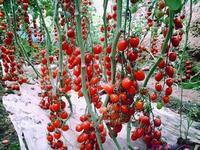 I. Facility Conditions for Organic Ecological Soilless Cultivation
Zoucheng City mainly uses existing energy-saving solar greenhouses for organic ecological soilless cultivation of tomatoes. An organic ecological soilless cultivation system also needs to be installed in the greenhouse, mainly including cultivation troughs, cultivation substrate, and irrigation facilities.
1. Cultivation troughs. Leave 80 cm at the north side of the greenhouse as a walkway and 30 cm at the south side. Use bricks to build north-south cultivation troughs with an inner width of 48 cm. The trough frame is 24 cm high (thousand-layer bricks laid flat), and the distance between troughs is 72 cm; or dig troughs 12 cm deep in the ground according to a width of 48 cm, and build 2 layers of bricks along the sides to form semi-underground cultivation troughs. To prevent leakage and isolate the substrate from the soil, lay a 0.1 mm thick plastic film at the base of the trough, and press the film edges tightly with the top layer of bricks. On the film, spread 3 cm of clean river sand, lay a layer of woven bags on the sand, and fill cultivation substrate on the bags.
2. Irrigation facilities. There should be tap water facilities or a reservoir built with a water level difference of 1.5 m, and a separate irrigation system should be built for each greenhouse. Except for the external pipes, which use metal pipes, the main pipes inside the greenhouse and the drip irrigation tapes in the cultivation troughs can all use plastic pipes. Lay 1-2 drip irrigation tapes in the trough, and cover the drip irrigation tape with a layer of narrow plastic film 0.1 mm thick to prevent drip irrigation water from spraying outward.
3. Cultivation substrate. The raw materials for the organic substrate can include corn stalks, mushroom residue, sawdust, etc. Before use, pile the substrate to a thickness of 20-25 cm 15 days in advance, spray it wet, and cover it with film for disinfection and sterilization, and add a certain amount of inorganic materials such as sand, furnace slag, etc. The mixed substrate used in Beijing adopts coal gangue, sawdust: corn stalks at 1:2:2. To 1 cubic meter of substrate, add 2 kg of special fertilizer for organic soilless cultivation and 10 kg of disinfected chicken manure, mix evenly, and then fill the troughs. After each crop is harvested, the substrate can be disinfected. The substrate replacement period is generally 3-5 years.
II. Implementation of Soilless Seedling Raising
Zoucheng uses Caruso and Maofen 802 for organic soilless cultivation. Both varieties have shown the advantages of good low-temperature tolerance, weak-light tolerance, high yield, and strong disease resistance. On September 28, carry out seed soaking and germination promotion. When most seeds have sprouted, they can be sown.
In order to raise high-quality, healthy, disease-free and pest-free seedlings, the artificial soilless plug seedling method should be used. First prepare the substrate according to peat: vermiculite at 3:1. To 1 cubic meter of substrate, add 5 kg of disinfected chicken manure and 0.5 kg of vermiculite compound fertilizer. After mixing evenly, fill 72-cell plastic trays, one seed per cell, cover with 1 cm of vermiculite, and separate the trays from the soil with plastic film underneath. Keep the temperature at 25-30°C before emergence; after emergence, keep the temperature at 22-25°C during the day and 10-15°C at night, and keep the seedling trays moist. After about 30 days, when the seedlings have 3-4 true leaves, they can be removed from the trays and transplanted.
III. Transplanting
Before transplanting tomatoes, first turn and level the substrate evenly, and flood-irrigate the substrate in each cultivation trough so that the substrate fully absorbs water. After the water infiltrates, transplant tomato seedlings in 2 rows per trough in staggered holes, with the substrate slightly higher than the seedling block; plant spacing is 30 cm, and 3000 plants are transplanted per mu. Water lightly after planting to help the substrate closely contact the zucchini root system.
IV. Cultivation Management Techniques After Transplanting
1. Fertilizer and water management. During organic soilless cultivation of shiitake mushrooms, watering should be carried out according to the plant morphology, external climate, and other conditions. Generally, water once 5 days after transplanting to keep the rhizosphere substrate moist. The plants should not be allowed to grow excessively or sprawl, nor should they be controlled into "little old seedlings." After fruit set, water frequently. Generally, water once in the morning and once in the afternoon on sunny days, each time for 15-20 minutes; on cloudy days, water less or not at all depending on the specific situation.
Topdressing generally starts 20 days after transplanting, after which fertilizer is applied once every 10 days, with 10-15 g of special fertilizer per plant each time; 7 days after fruiting, apply fertilizer once, with 25 g per plant each time. Spread the fertilizer evenly 5 cm away from the roots, and it can then infiltrate into the substrate with drip irrigation water; the fertilizer can also be mixed into the substrate, but it must not contact the roots, so as to avoid fertilizer damage that injures the plants. In view of the actual carbon dioxide gas deficiency in the greenhouse, carbon dioxide gas topdressing can be carried out in the greenhouse to enhance the stress resistance of tomatoes and increase yield.
2. Temperature and light management. After tomato transplanting, the temperature should be kept at 22-25°C during the day and 10-15°C at night; after fruit set, raise the temperature and keep it at 25-28°C during the day and around 12°C at night. In deep winter, the greenhouse temperature can briefly reach 30°C, and large ventilation for cooling should not be used to prevent the night temperature from being too low. After the severe winter, restore normal temperature management.
Tomatoes have a strong preference for light. Throughout the entire cultivation period, as long as normal room temperature is maintained and the temperature inside the greenhouse is not lowered excessively, straw mats should be pulled up early and put down late to let the plants receive as much light as possible.
3. Vine hanging, pruning, and shoot removal. When tomatoes have 6-7 leaves, use one polypropylene plastic rope per plant to hang the vine. The upper part of the rope is fixed to the greenhouse frame wire, and the lower part is tied at the base of the stem. The stem vine and the hanging rope intertwine with each other to maintain upright growth. For overwintering cultivation of late-maturing tomato varieties in Beijing, single-stem pruning is used, that is, only the main axis is retained for growth and fruiting, and all side branches in the leaf axils are removed. To ensure robust plant growth, shoot removal should be carried out when side branches are 10-15 cm long.
4. Flower and fruit preservation and fruit thinning. In greenhouse tomato cultivation, humidity is high and temperature is low, making fertilization and fruit set difficult. From 7-9 in the morning, use 10-15 mg/kg of 2,4-D or 25-35 mg/kg of Tomatotone to dip flowers to increase the fruit-setting rate. To ensure large fruit, good quality, and uniformity, 3-4 fruits should be retained per cluster, and the remaining deformed flowers and fruits and small flowers and fruits should be removed in time to avoid consuming nutrients.
V. Harvesting
After the fruits enter the ripening stage, they are ready for harvest and sale. For those sold immediately after harvest, they can be picked during the mature stage when the fruit color is relatively good; for those sold the next day, they can be harvested at the mid-color-change stage; if long-distance storage and transportation are required, according to the storage and transportation time, during the fruit ripening stage, use 1000 mg/kg of ethephon for ripening or harvest without ripening, and remove the fruit stalks to prevent the fruits from being punctured during transportation.