Causes of Deformed Potato Tubers and Control Measures
Deformed potato tubers are a problem that some growers overlook while single-mindedly pursuing higher yields: deformed tubers often appear during tuber growth, especially in the spring crop of double cropping, where high temperatures and drought lead to a high proportion of deformed tubers, seriously affecting the marketability of potatoes and greatly reducing potato...
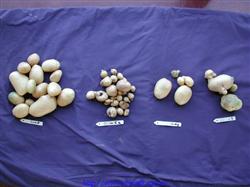
Deformed potato tubers are a problem that some growers overlook while single-mindedly pursuing higher yields: deformed tubers often appear during tuber growth, especially in the spring crop of double cropping, where high temperatures and drought lead to a high proportion of deformed tubers, seriously affecting the marketability of potatoes and greatly reducing the economic benefits of potato cultivation. The causes of deformed potato tubers and control measures are summarized below for everyone's reference in production.
I. Causes of Deformed Tubers
Deformed potato tubers are mainly caused by secondary growth. The main cause of secondary growth is sudden rainfall or watering after high temperatures and drought, which puts tubers that had stopped growing back under suitable growing conditions; however, by this time the tuber skin is partially or entirely aged, while the buds in the non-aged parts resume growth and starch synthesis, thus forming various deformities.
II. Control Measures
1. Select excellent varieties Deformed tubers mostly occur in mid-season or mid-late-season varieties, so when planting potatoes, especially on poorly drained or heavy clay soil, or in areas where local conditions do not allow watering and where the potato growing period is hot with little rain, varieties not prone to secondary growth should be selected according to local cultivation conditions and adapted to local conditions.
2. Apply more organic fertilizer Organic fertilizer contains various macroelements and microelements needed for potato growth and development. Applying organic fertilizer can make the soil loose and fertile, improve soil aeration, and enhance the soil's water- and fertilizer-holding capacity, avoiding tuber deformities caused by soil that is too dry or too wet, while also promoting tuber expansion, making tuber shape uniform and skin smooth, and increasing yield. Especially when planting potatoes on clay soil, more attention should be paid to applying more organic fertilizer to improve soil conditions. Organic fertilizer should generally be applied as a base fertilizer and applied deeply, with 4000-5000 kg per 667 sq m on plots of ordinary fertility.
3. Apply fertilizer in appropriate amounts Excessive fertilization of potatoes easily leads to vigorous growth or even excessive vegetative growth of the plants; if corresponding cultivation and management measures are not kept up in time, tuber expansion will be inhibited, resulting in deformities. Potato is a potassium-demanding crop, absorbing the most potassium, followed by nitrogen, and the least phosphorus. Fertilizer can be applied in two ways: base fertilizer and topdressing. Base fertilizer is mainly organic fertilizer, and early topdressing is mainly nitrogen fertilizer to promote rapid growth of aboveground stems and leaves, generally applying 10-15 kg of urea or 40-50 kg of ammonium bicarbonate per 667 sq m, with topdressing 1-2 times throughout the growth period; the amount and frequency of topdressing depend on soil fertility and plant growth, and excessive fertilization is strictly prohibited. During the tuber-setting stage, to promote tuber growth, a suitable amount of potassium fertilizer can be supplemented by foliar spraying, generally using a concentration of 1‰ potassium dihydrogen phosphate.
4. Water in time During the seedling stage, potatoes generally do not need watering. When the soil is too dry, watering must be carried out, but after watering, intertillage should be done in time to break up surface crusting and raise soil temperature. After potatoes bud, they should be watered frequently in small amounts according to soil moisture to keep the soil moist and the surface from drying out, generally watering once every 7-10 days. According to soil conditions, watering is generally stopped 5-7 days before harvest, which helps ensure safe storage of tubers after harvest. Avoid drought during the growth period; especially if drought occurs during the tuber expansion stage and watering is then carried out, it will cause secondary growth of tubers and form deformed tubers.
5. Strengthen intertillage and hilling The main role of intertillage and hilling is to improve soil aeration and increase the soil's capacity to conserve moisture and fertilizer, making tuber skin smooth and tuber shape uniform and reducing the proportion of deformed tubers. Throughout the potato growth period, 2-3 intertillages and 2 hillings should be carried out as needed. The first intertillage is done 3-5 days before emergence, the second after the seedlings have all emerged, and the last intertillage should be completed before the potato rows close. The first hilling is done at the budding stage when the tips of the stolons begin to expand, to prevent stolons from emerging above the ground and becoming new branches. When potatoes enter the peak expansion stage, a second hilling is done to prevent tubers from being exposed above the ground, with a hilling thickness of 4-5 cm, forming high ridges about 25 cm tall, so that watering does not submerge the tops, the ridges do not crust, and the soil has good aeration, which is favorable for tuber expansion.