How do you identify and control Colorado potato beetle damage?
The Colorado potato beetle, also known as the Colorado potato leaf beetle, is a class I quarantine pest in China. This insect originally lived on wild solanaceous plants on the eastern slopes of the Rocky Mountains in the western United States. Because cultivated potatoes provide this beetle with good nutrition, and because potatoes are widely grown and transported around the world, ...
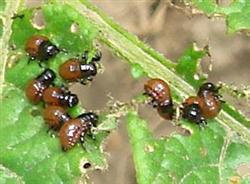
The Colorado potato beetle, also known as the Colorado potato leaf beetle, is a class I quarantine pest in China. This insect originally lived on wild solanaceous plants on the eastern slopes of the Rocky Mountains in the western United States. Because cultivated potatoes provide this beetle with good nutrition, and because potatoes are widely grown and transported around the world, the Colorado potato beetle has gradually become an internationally recognized important quarantine target. In China, it was first found in the **Ili region in 1993. Although it is still controlled in localized areas of **, the areas nationwide suitable for its occurrence are very extensive. All localities should strengthen monitoring, achieve early detection, and strictly prevent and control it.
The Colorado potato beetle is relatively easy to identify. The adult is short and oval, 9.0-11.5 mm long, with a base color of light yellow or yellowish brown overall. Each elytron has 5 longitudinal black stripes, and the pronotum has more than a dozen black spots, of which the middle two are the largest and form a "U" or "V" shape. The larvae are dark brown to orange-yellow, with two rows of large dark sclerites on each side, and the abdomen is swollen and raised. The 4th-instar larva is about 15 mm long. Egg masses are laid on the underside of leaves and are elongated oval, pale yellow or deep orange-yellow.
The Colorado potato beetle has 1-4 generations per year. One notable feature is that its adults live a long time, averaging up to 1 year, and can overwinter in the soil. They are resistant to starvation, can migrate more than a thousand meters with the wind, and can also hide in seed potatoes, agricultural products, seeds, seedlings, and packaging materials to travel long distances by aircraft, ships, trains, automobiles, and other means of transport. Field surveys should be conducted on sunny days and not in the morning or evening.
Another characteristic of the Colorado potato beetle is that it likes to feed on important crops such as potatoes, tomatoes, eggplants, and tobacco. Its adults and larvae specifically eat potato leaves or growing tips. It reproduces quickly and eats a great deal, often biting the leaves into notches or even eating them completely bare.
At present, the focus of controlling the Colorado potato beetle is to strictly implement transfer quarantine procedures, strictly control the movement, and prevent potato tubers and live plants from being shipped out of infested areas. Other solanaceous host plants and packaging materials from infested areas should be quarantined and subjected to disinfestation treatment according to regulations. For areas suitable for the Colorado potato beetle, epidemic monitoring should be strengthened and systems should be improved. In areas where it has already occurred, comprehensive control measures should be implemented, including autumn plowing and winter irrigation, rotation with non-solanaceous vegetables and crops, manual capture and killing, and chemical control. For chemical control, use chlorpyrifos (Lorsban) and pyrethroid insecticides, such as 25% cyhalothrin (Kung Fu) at 30 grams per mu, 20% fenvalerate (Sumicidin) at 40-50 grams per mu, and 2.5% deltamethrin (Decis) at 20-30 grams per mu, diluted with water and sprayed. Because the Colorado potato beetle readily develops resistance to organophosphorus and pyrethroid insecticides, fipronil (Regent), acetamiprid, imidacloprid, and Bacillus thuringiensis preparations can be used alternately.