High-Efficiency Cultivation Technique for Multiple Cropping of Winter Lettuce Followed by Early Spring Peppers in Greenhouses
For lettuce, choose the disease-resistant, high-yielding, cold-tolerant lettuce variety Shuiguasi. Sow and raise seedlings in a small arch shed from late August to late September. After sowing, lower the temperature during the day by ventilating the shed film from the bottom and covering with a shade net; on rainy nights, cover the shed film properly. From pricking out to the seedling recovery stage, shade during the day to create an ambient temperature suitable for lettuce growth...
Lettuce: Choose the disease-resistant, high-yielding, cold-tolerant lettuce variety Shuiguasi. Sow and raise seedlings in a small arch shed from late August to late September. After sowing, lower the temperature during the day by ventilating the shed film from the bottom and covering with a shade net; on rainy nights, cover the shed film properly. From pricking out to the seedling recovery stage, shade during the day to create an ambient temperature suitable for lettuce growth. Control watering as much as possible; do not water unless the plants are dry, to prevent leggy seedlings. Transplant into the greenhouse when the seedlings are 35 days old. Apply 5000 kg of decomposed organic fertilizer and 50 kg of NPK compound fertilizer per mu as a base fertilizer, prepare the land and make beds, with a planting row spacing of 50 cm and plant spacing of 35 cm, planting about 3500 plants per mu. Water immediately after transplanting. During the seedling recovery period, ventilate when the shed temperature exceeds 20°C, keeping the daytime temperature inside the shed no higher than 25°C and the nighttime temperature at 3-10°C. After the temperature drops, add straw curtains at night around the Start of Winter for insulation, and use double-film and double-straw-cover coverage when the temperature is low. For fertilizer management, apply light seedling-promoting fertilizer and heavy fertilizer at the rosette stage. Pay attention to preventing and controlling downy mildew, sclerotinia rot, soft rot and other diseases. Use 64% Sandofan at 500 times dilution to control downy mildew, 40% Dimethachlon at 1000 times dilution to control sclerotinia rot, and 90% Xinzhimeisu or 72% agricultural streptomycin at 1300 times dilution to control soft rot.
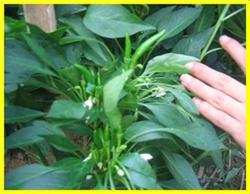
Peppers: Choose the high-yielding, disease-resistant Haifeng 68 extra-large ox-horn pepper variety. Sow and raise seedlings in the greenhouse from late October to early November. During seedling raising, use double-film coverage and add double-layer straw curtains for insulation. Prick out seedlings at the 3-leaf 1-heart stage, transplant when flower buds appear, with a seedling age of about 100 days. After harvesting the lettuce, prepare the land, apply fertilizer and make beds in time. In the first and middle ten days of February, when the greenhouse temperature stabilizes at 10-12°C, transplant with a row spacing of 60 cm and plant spacing of 35 cm, planting 3000 plants per mu. After transplanting, water once for seedling recovery and cultivate 2-3 times; after seedling recovery, control growth by withholding water. After the first pepper has set, apply 7.5 kg of urea and 4-6 kg of potassium sulfate per mu along with watering; during the full fruit stage, water lightly once every 7-10 days, and apply fertilizer with every other watering, each time applying 5-10 kg of urea and 8-10 kg of potassium sulfate per mu with the water; during the harvest period, apply 15-20 kg of diammonium phosphate as a top dressing along with watering. During the seedling recovery period, maintain the daytime temperature at 28-32°C and the nighttime temperature at 18-20°C; during the fruiting period, maintain 25-30°C during the day and 18-20°C at night. During plant growth, regulate the relative humidity at 50%-70% through measures such as controlling watering and ventilation. Remove side branches and old leaves below the first pepper in time, and remove diseased and old leaves in time during the middle and late stages of plant growth to facilitate ventilation and light penetration. The main diseases of peppers are phytophthora blight and brown spot. Use 25% Amistar at 1500 times dilution or 64% Sandofan at 500 times dilution, or Jinlei at 600 times dilution to control phytophthora blight, and use 77% Kocide at 1000 times dilution or 50% thiophanate-methyl at 600 times dilution to control brown spot. Harvest the first and opposite peppers early to prevent plant decline. Harvest in time during the full fruit stage to avoid affecting fruit set on the upper part of the plant.