What to do when pepper seedling transplanting to control excessive growth goes wrong
Soilless cultivation for raising seedlings mainly means that instead of using soil and farmyard manure in the seedling tray as the seedling substrate, peat and vermiculite are mixed at a ratio of 3:1 and used as the seedling substrate. Put the mixed seedling substrate into the seedling trays, stack several seedling trays filled with the seedling substrate together, place a wooden board on top, press down with a little force,...
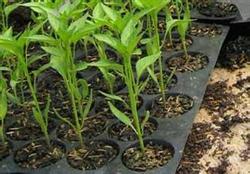 At present, some vegetable growers, because their greenhouses have not yet been cleared out while the pepper seedlings are growing very fast, have adopted the method of transplanting seedlings to control excessive growth in order to prevent the seedlings from growing leggy, especially since many seedlings have already grown to the 6-8 true leaf stage. In response, the reporter believes this method is highly inadvisable.
First, transplanting seedlings damages the roots, prolongs the seedling stage, and easily leads to root aging and weakened regeneration capacity, affecting the growth vigor of the seedlings after planting. The seedling stage is the period when the root system is most delicate and fragile. During transplanting, although the seedling soil is loose and few roots are broken, the root system is still greatly damaged. Transplanting prolongs the seedling age and easily leads to root aging and weakened regeneration capacity, resulting in slow growth and weak vigor after planting.
Second, during transplanting, wounds are easily formed on the roots and stems, affecting the disease resistance of the seedlings. In recent years, root diseases have become the most important diseases restricting vegetable production. When vegetables are transplanted, root damage is unavoidable, and the wounds formed become excellent sites for pathogen infection, easily leading to disease outbreaks. At the same time, the fine hairs on the stems of pepper seedlings play a very important role in reducing pathogen spread and infection. However, transplanting unavoidably damages the fine hairs on the stems, leading to reduced plant disease resistance and possibly increased disease occurrence.
In addition, flower bud differentiation is greatly affected. The flower bud differentiation of most vegetables begins from the 2-4 true leaf stage. If root damage, diseases, and other problems occur during this period, they will inevitably affect the root system's absorption of water and nutrients and the photosynthesis of leaves, causing the plants to receive insufficient nutrients, delaying flower bud differentiation and causing poor differentiation, resulting in many deformed fruits and low yield in the early stage after planting.
Planting small seedlings is more beneficial to vegetable growth and development. Before sowing or thinning to a final stand, vegetable growers must calculate the time well and must not do it too early, so as to avoid the seedlings becoming too large before planting and forcing growth control, which affects the growth and development of the seedlings after planting. If the seedlings are indeed too large and cannot be planted for the time being, the seedlings in the plug trays can first be transplanted into nutrient pots, and by limiting their growth space and nutrient range to help them grow, the seedling age can be prolonged.