Temperature management methods during pumpkin cultivation
①Practice rational crop rotation, and select excellent disease-resistant varieties according to local conditions. Before sowing, the seeds should be soaked. They can be soaked for 20 minutes in a 500-fold dilution of 50% carbendazim wettable powder plus an 800-fold dilution of New High Lipid Membrane, then rinsed clean with water and sprouted. After sowing, promptly spray New High Lipid Membrane to retain heat and moisture, prevent soil crusting, and improve seedling emergence...
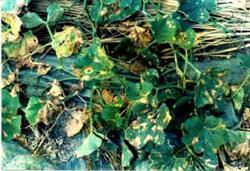 For winter-spring pumpkin cultivation in greenhouses in northern China, the seedling stage falls in the coldest midwinter period of the year, with the shortest daylight and the lowest temperatures, making cultivation extremely difficult. Low temperature and insufficient light become the main factors limiting pumpkin growth. Therefore, how to increase light, raise temperature and maintain temperature is the key to successful cultivation. In a solar greenhouse with a span of 7-8 m, the ridge must not be lower than 3 m in order to increase the light-receiving surface; reflective screens can also be hung on the back wall to enhance indoor light; use EVA anti-drip film (ethylene-vinyl acetate polymer) with good light transmittance as the greenhouse film; frequently clean dust off the greenhouse film to keep it clean and light-transmitting. Heat preservation mainly involves increasing wall thickness (not less than 1 m), digging cold-proof trenches, and using coverings with good insulation performance. Two layers of straw mats or one layer of straw mats plus one layer of paper quilt can be covered over the greenhouse film. In areas at 43°N latitude, using cotton quilts or chemical fiber wool blankets gives better insulation. In the early stage of plant growth, on the one hand it is necessary to prevent root rot and damping-off caused by low temperature and high humidity, and on the other hand it is also necessary to prevent excessive vegetative growth caused by high temperature, high humidity and weak light. In terms of temperature management, in the early growth stage (meaning from planting to the first fruit set), the daytime temperature should be 25°C, and the nighttime temperature should be 16-18°C; in the middle and late growth stages (meaning from fruit set to maturity), the daytime temperature can be raised to 27°C, with a nighttime temperature of 17°C, to accelerate fruit growth and development and facilitate early maturity and high yield.