Detailed Explanation of Key Techniques for Autumn Pumpkin Cultivation
Pumpkins have a strong root system with deep and extensive distribution, strong stress resistance, and a powerful ability to absorb water and nutrients. When pumpkins are cultivated in greenhouse soil with high fertility levels, the stems and leaves often become excessively lush, frequently causing flower and fruit drop, resulting in low yields. Therefore, when cultivating pumpkins in arched sheds, management must be strengthened, with appropriate close planting and controlled...
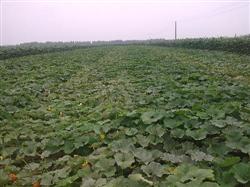 Variety Selection: Choose varieties with excellent quality and good taste, such as Miben pumpkin and the introduced Japanese Chestnut Self-Man and other varieties. Locally superior varieties may also be selected.
Sowing and Seedling Raising: Based on production practices in recent years, the suitable sowing period for autumn pumpkins is from mid-July to early August. First soak pumpkin seeds in 50°C hot water for 10 minutes, then soak in warm water for 8 hours and remove, then germinate in a 26°C-30°C environment until the seeds sprout white. For seedling raising, it is best to use nutrient pots, sowing one germinated seed per pot with the radicle facing down, covering with 1-1.5 cm of fine soil. After sowing, water the seedbed thoroughly with a 1500-fold dilution of 50% carbendazim, then cover with a layer of straw or weeds. When 1/3 of the seedlings emerge, remove the covering. After 15-17 days of seedling age. Direct sowing without seed soaking and germination is also possible.
Land Preparation and Transplanting: Before plowing, apply 2500 kg of decomposed farmyard manure, 25 kg of potassium sulfate compound fertilizer, and 20 kg of potassium sulfate per 667 sq m, then deep plow and harrow thoroughly. Then form ridges with a width of 80 cm (including furrow) and a height of 12-15 cm, shaped like a turtle back. Plant one row per ridge, with a row spacing of 2.5-3 m and a plant spacing of 0.5 m. Transplanting should be done after 5 PM or on cloudy days. After transplanting or direct sowing, water thoroughly once to help with seedling recovery or emergence.
Field Management: The manual pollination method is to pick a blooming male flower, remove the petals, and directly place it over the female flower so that pollen falls naturally onto the female flower stigma; or gently smear the stamens with petals removed onto the female flower stigma, which can also achieve the purpose of manual pollination. In addition, when pumpkins grow 3-4 true leaves, spray a 2500-fold dilution of ethephon to promote early opening of female flowers and early fruit setting. Fertilizer and water management can be carried out after the second fruit sets, based on the growth condition of the vines.
Pest and Disease Control: The main pests of autumn pumpkins include aphids, thrips, melon borers, and leafminers. When aphids, thrips, and spider mites occur, use a 2000-fold dilution of 10% Dachenggong, or 2000-fold dilution of Scorpion for control. For leafminers, use a 1000-fold dilution of 10% cyromazine for control. For melon borers, use 20 ml of 5% fipronil per 667 sq m mixed with 25 kg of water for spray control. For viral diseases, use 800-1000-fold dilution of Shu jun cheng plus 20% Virus A prepared as a 300-fold solution for control.