High-Yield Cultivation Techniques for Autumn-Winter Zucchini in Greenhouses
I. Selecting Excellent Varieties First, choose the early-maturing, high-yielding, fast-growing "Zaoqing No. 1" zucchini hybrid, which has trailing-vine characteristics. II. Raising Strong Grafted Seedlings 1. Sowing time. The sowing time for autumn-winter zucchini in greenhouses is generally from early September to mid-September, with a seeding rate of 500 g per mu...
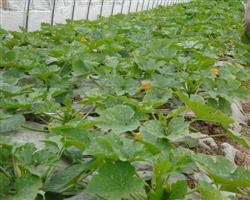
I. Selecting Excellent Varieties
First, choose the early-maturing, high-yielding, fast-growing "Zaoqing No. 1" zucchini hybrid, which has trailing-vine characteristics.
II. Raising Strong Grafted Seedlings
1. Sowing time. The sowing time for autumn-winter zucchini in greenhouses is generally from early September to mid-September, with a seeding rate of 500 g per mu; the rootstock black-seed squash requires 800-1000 g of seed, sown at the same time as the zucchini.
2. Grafting methods: insert grafting and approach grafting can be used. Insert grafting: first lift out both types of seedlings, remove the true leaves of the black-seed squash with a bamboo stick, then make a hole between the two cotyledons, then remove the roots of the zucchini scion seedling, cut it into a cone shape at 0.5-0.8 cm from the hypocotyl, water thoroughly and cover the greenhouse.
3. Grafting time. Using sand beds for seedling raising, raise the zucchini and black-seed squash separately in two sand beds, and begin grafting when the true leaves of the seedlings appear. Generally about 5 days from sowing to grafting.
4. Seedling-stage management. After the grafted seedlings are planted into nutrient pots, the greenhouse should be closed in time to maintain the temperature at 20-25°C. 2-4 days after grafting, provide appropriate shade during strong midday light, and after 5 days ventilate appropriately to harden the seedlings. The humidity inside the greenhouse for grafted seedlings must be kept above 75%. At the same time, promptly remove the regenerated leaves of the black-seed squash.
III. Field Planting
1. Land preparation and basal fertilizer application. Before transplanting into the greenhouse, apply sufficient basal fertilizer: 1500-2000 kg of decomposed farmyard manure per mu, 100-150 kg of fermented rapeseed cake, 50 kg of ternary compound fertilizer, and 10 kg of urea. Spread evenly, then plow the land and make beds, leveling and fining the soil. The bed width is 0.8 m, bed height 0.1 m, and ditch width 0.5 m, then cover with plastic film and wait for planting.
2. Punching holes and planting. Punch holes at a plant spacing of 0.45 m, plant 2 rows per ridge, water thoroughly, and transplant and close the ridge after the water has soaked in. The transplanting time is early to mid-October, with about 2500 plants per mu.
IV. Management During the Greenhouse Growing Period
1. Temperature management. After planting, zucchini grows rapidly. After November, water lightly as appropriate, then close the greenhouse and weed in time, and remove the regenerated leaves of the squash. After winter begins, cover in time for insulation to ensure normal growth of the zucchini.
2. Fertilizer and water management. Before zucchini flowers and sets fruit, water as little as possible. After the fruit has set, water lightly as appropriate. After winter begins, basically no watering is needed; only foliar fertilizer is applied together with pesticide spraying.
3. Hanging vines and pruning. "Zaoqing No. 1" zucchini has trailing-vine characteristics; cultivating with hanging vines can increase planting density, prolong the growing period, set fruit earlier, and increase yield. Hanging vines is an important measure for high-yield and high-efficiency zucchini. In early November, vines should be hung in time, and excess side branches should be removed at the same time to reduce nutrient consumption.
4. Increasing the fruit-setting rate. To increase the fruit-setting rate of zucchini, carry out artificial pollination in time, then coat the fruit stalk with 10-15 mg/L 2,4-D solution, or dip the flowers in Shennong No. 2 aqueous solution, to prevent flower and fruit drop and promote uniform fruit enlargement.
5. Pest and disease control. The main insect pest of zucchini is aphids, controlled with 40% omethoate. The main diseases are powdery mildew, gray mold, etc., which can be controlled with 70% chlorothalonil 700-fold solution.