What are the control methods for zucchini gray mold?
In recent years, the area of zucchini grown in solar greenhouses has been relatively large, and the occurrence of zucchini gray mold often causes tender squash to rot, affecting yield and profitability. Therefore, measures should be taken for integrated control. Grafting for disease prevention. Using Yunnan black-seeded squash (Cucurbita ficifolia) as rootstock and zucchini as scion for grafting can increase zucchini's resistance to...
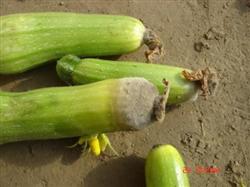
In recent years, the area of zucchini grown in solar greenhouses has been relatively large, and the occurrence of zucchini gray mold often causes tender squash to rot, affecting yield and profitability. Therefore, measures should be taken for integrated control.
Grafting for disease prevention. Using Yunnan black-seeded squash (Cucurbita ficifolia) as rootstock and zucchini as scion for grafting can increase zucchini's ability to resist gray mold.
Trellising cultivation. When the zucchini grows to 8 leaves, begin trellising. Stretch a wire above each row of plants running north-south, and for each zucchini plant, tie a nylon string to the wire to hang vertically down to the roots, then tie the end of the string to the base of the zucchini plant, so that the hanging string and the stem vine become intertwined.
Chemical flower dipping. After the zucchini blooms, during the daily morning flower dipping, add 0.1% procymidone to 2,4-D, which can effectively control zucchini gray mold.
Chemical control. You can use 50% procymidone wettable powder at 1500-2000 times dilution, or 50% iprodione wettable powder at 1000-1500 times dilution, 70% zineb wettable powder at 400 times dilution, or 50% carbendazim wettable powder at 500 times dilution for spraying, spraying once every 6-7 days, for 2-3 consecutive sprays, with 45-60 kg of spray solution per mu each time.
Strengthen field management. Clean up diseased plant debris thoroughly, maintain field sanitation, prevent the spread of pathogens, and control temperature. Use under-film dark irrigation or drip irrigation for watering, and nighttime humidity should be less than 80%. When humidity is high, measures should be taken to reduce it. In the later stage of production, promptly remove old leaves, increase ventilation and light penetration, so that the plants grow robustly and their disease resistance increases.