Different base fertilizers for zucchini mean different fertigation methods
In the middle and late stages of zucchini growth in a solar greenhouse, poor indoor ventilation and light transmission, a closed crop canopy, and weak photosynthetic capacity make plants prone to early senescence and low yields. In recent years, vegetable growers in Dongkan Town, Binhai County, Jiangsu, have worked out a set of vine-pressing cultivation techniques that allow the zucchini growing period to be extended from September of the first year to June of the following year, with a yield of 10,000 per mu...
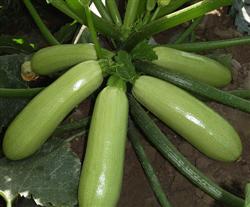 After zucchini sets fruit, the plant transitions from vegetative growth to reproductive growth. Fruit expansion requires the absorption of large amounts of nutrients, competing with the nutrients needed for plant growth. To ensure that vegetative growth and reproductive growth proceed simultaneously, fertigation is needed at this time. But fertigation cannot be done blindly; first of all, it should be determined according to soil fertility. To put it simply, fertigation should be carried out according to the different base fertilizer use situations of vegetable growers. Note that the following two points should be achieved:
For those whose base fertilizer is mainly manure and organic fertilizer, with little or no chemical fertilizer, note: 1. Because little chemical fertilizer is used, quick-acting chemical fertilizer can be appropriately applied by fertigation to avoid affecting fruit growth; 2. The amount of the first fertigation can be appropriately increased, and an appropriate amount of compound fertilizer with a longer fertilizer effect should be added. Generally, a high-potassium compound fertilizer can be chosen at 10-15 kg per mu applied by fertigation, mixed with 30-40 kg of organic fertigation fertilizer; 3. The fertigation cycle can be appropriately shortened, with one more fertigation, so that the phenomenon of early senescence and weak plants in zucchini will not occur; 4. The selected fertigation fertilizer can be amino acid-based, humic acid-based, or fulvic acid-based, but a low-nitrogen, high-potassium type that does not contain hormones should be chosen to prevent early senescence.
For those whose base fertilizer contains sufficient and balanced manure, organic fertilizer, and chemical fertilizer, note: 1. Apply fertigation at the right time, and topdress in a timely manner according to the fertilizer requirements of the crop at each growth stage, so as not to affect normal fruit growth; 2. Apply fertigation in the right amount to prevent excessive fertilizer from causing fertilizer damage, with 30-40 kg of organic fertilizer per mu applied by fertigation being appropriate; 3. Low-nitrogen, high-potassium fertilizer is most suitable.