Key Technical Points for Fertilization During the Seedling Stage of Zucchini
Soil preparation and fertilization: Zucchini prefers slightly acidic soil, with a suitable pH value of 5.5 to 6.8. Zucchini has a very strong nutrient uptake capacity; applying too much nitrogen fertilizer easily causes excessive vegetative growth of stems and leaves, leading to flower and fruit drop and the occurrence of diseases. Therefore, nitrogen, phosphorus, and potassium should be applied in combination. Under normal circumstances, for every 1000 kg of fruit harvested, it needs to absorb 3.92 kg of nitrogen...
Soil preparation and fertilization: Zucchini prefers slightly acidic soil, with a suitable pH value of 5.5 to 6.8. Zucchini has a very strong nutrient uptake capacity; applying too much nitrogen fertilizer easily causes excessive vegetative growth of stems and leaves, leading to flower and fruit drop and the occurrence of diseases. Therefore, nitrogen, phosphorus, and potassium should be applied in combination. Under normal circumstances, for every 1000 kg of fruit harvested, it needs to absorb 3.92 kg of nitrogen, 2.13 kg of phosphorus, and 7.29 kg of potassium. The order of absorption of the five elements is potassium greater than nitrogen greater than calcium greater than phosphorus greater than magnesium.
Seed soaking and germination: First, put the seeds into clean water and remove the immature seeds floating on the water surface, then soak the seeds in warm water at 55°C to 60°C for 10 minutes to kill pathogens on the seed coat, then soak them in warm water at 20°C to 30°C for about 4 hours. After removing them, drain the water, wrap them in moist gauze, and germinate them at 28°C to 30°C. Once the seeds crack and show white, they can be sown.
Sowing and seedling raising: Whether using seedbed seedling raising or nutrient pot seedling raising, nutrient soil must first be prepared well, which is the key to cultivating strong seedlings. Take 3 parts of fertile garden soil that has not grown cucurbits within 4 years, one part of decomposed barnyard manure, add a small amount of plant ash and sawdust, mix evenly, sift, then form beds or fill nutrient pots. Once prepared, sowing can begin, covering with soil 2 cm thick. After completing this step, a small amount of bran mixed with methamidophos should be scattered on the bed surface to prevent and control underground pests, then cover with a small arched shed film to seal in moisture until seedlings emerge.
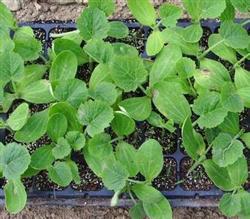
The standard for age-appropriate strong zucchini seedlings is: calendar seedling age of about 30 days, with 3 to 4 true leaves, plant height of about 10 cm, stem diameter of 0.5 cm, petiole length equal to leaf blade length, dark green leaf color, intact cotyledons, and well-developed root system.
Temperature management during the seedling stage: Keep the daytime temperature at 20°C to 25°C; when it exceeds 25°C, ventilate to cool down. Keep the nighttime temperature at 10°C to 15°C, and do not let it fall below 6°C. During this period, scientifically and appropriately control moisture. If obvious symptoms of water deficiency appear, water lightly; after watering, pay attention to ventilation, reduce air temperature, and prevent disease occurrence. To prevent diseases such as damping-off and fusarium wilt, a small amount of Wanku Yiguanling can be added to irrigate the roots twice; to prevent leaf diseases, spray the leaves with thiophanate-methyl or chlorothalonil once every 7 days; to prevent damage to seedlings by greenhouse whiteflies, aphids, cabbage caterpillars, and leafminers, spray targeted insecticides once every 5 to 7 days.