Early control methods for four onion diseases
The main onion diseases are downy mildew, gray mold, rust and soft rot, and they should be controlled early. Downy mildew and gray mold Downy mildew mainly damages the outer leaves and flower stalks of onions. The suitable temperature for the disease is 10-20°C, and it can occur from April to May or from November to December. At the beginning of the disease, affected plants show oblong or band-shaped sunken lesions on the outer leaves...
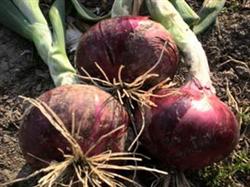
The main onion diseases are downy mildew, gray mold, rust and soft rot, and they should be controlled early.
Downy mildew and gray mold Downy mildew mainly damages the outer leaves and flower stalks of onions. The suitable temperature for the disease is 10-20°C, and it can occur from April to May or from November to December. At the beginning of the disease, affected plants show oblong or band-shaped sunken lesions on the outer leaves. The center of the lesion is dark yellow, and when air humidity increases, white downy mildew appears on the lesions. When the temperature is relatively high, diseased plants become stunted, the leaves often twist from the lesion, and finally the whole plant dies. Gray mold mainly damages onion leaves. At the beginning of the disease, small white spots appear on the leaves. In severe cases, the small white spots can number in the hundreds, and finally a gray mold layer appears on the leaves, followed by rot. The methods for controlling onion downy mildew and gray mold are similar. Agricultural measures: clear the ditches so that surface water can drain and subsurface water can seep away; apply decomposed organic fertilizer and increase the application of phosphorus and potassium fertilizer. Chemical measures: spray with Duoyangqing (3% polyoxin aqueous solution) at 600-800 times dilution, once every 7-10 days, for 3-4 consecutive treatments; or drench the roots or spray with 30% hymexazol aqueous solution at 1000-1500 times dilution; or spray with 25% metalaxyl wettable powder at 500 times dilution or 75% chlorothalonil wettable powder at 800 times dilution.
Rust Onions are prone to rust infection when the temperature is relatively low or fertility is insufficient. At the beginning of the disease, light yellow oval raised spots appear on the leaves and false stems. Later, the epidermis of the diseased parts ruptures and releases yellow-brown rust-colored powder. To control onion rust, spray with 15% triadimefon wettable powder at 2000 times dilution or 70% mancozeb wettable powder at 1000 times dilution. At the same time, use 20 ml of Pu K crop fungicidal repair solution per mu, add 40 kg of water, and spray.
Soft rot Onion soft rot is a bacterial disease, and the pathogen invades through wounds. The lower part of diseased leaves has milky white spots, the leaf tips turn yellow first and extend downward, the base of the leaf sheath softens and rots, and the bulb becomes water-soaked and rots with a foul odor. Some whole plants turn yellow and die; in some cases, rot starts from the neck of the onion bulb and then spreads to the whole plant. Agricultural measures: control pests to reduce wounds; pull out diseased plants and disinfect the diseased holes with lime or sulfur powder. Chemical measures: use 20 ml of Pu K crop fungicidal repair solution per mu, add 40 kg of water, and spray; or at the early stage of the disease, spray with 90% xinzhiromycin wettable powder at 5000 times dilution.