How to fertilize Chinese cabbage and radish? Master the nutrient requirements and fertilization methods
Chinese cabbage is an important leafy vegetable. Chinese cabbage has a very high yield, reaching over 5000 kg per mu, so it has relatively high fertilizer requirements. The ratio of the three is 1:0.4:1.1. Therefore, like other leafy vegetables, Chinese cabbage requires adequate nitrogen nutrition during the vegetative growth period, which is particularly important for promoting the formation of large leaves and increasing the photosynthetic rate...
Chinese cabbage
Chinese cabbage is an important leafy vegetable. Chinese cabbage has a very high yield, reaching over 5000 kg per mu, so it has relatively high fertilizer requirements. The ratio of the three is 1:0.4:1.1. Therefore, like other leafy vegetables, Chinese cabbage requires adequate nitrogen nutrition during the vegetative growth period, which is particularly important for promoting the formation of large leaves and increasing the photosynthetic rate. Because the growth amount and growth rate of Chinese cabbage differ at different growth stages, its requirements for nutrient conditions also differ. The general pattern of nutrient uptake is: nutrient uptake is low at the seedling stage, with the uptake of nitrogen, phosphorus and potassium amounting to less than 1% of total uptake; it increases markedly at the rosette stage, with uptake accounting for about 30%; uptake is greatest at the heading stage, accounting for about 70% of the total.
Key points of fertilization technology:
(1) Apply sufficient organic fertilizer. Applying sufficient base fertilizer is the foundation for obtaining a bumper harvest of Chinese cabbage. Generally, old vegetable garden soil has relatively high fertility, so organic fertilizer should be applied in an appropriate amount; while new vegetable garden soil has low fertility, so heavily applying organic fertilizer mixed with phosphate fertilizer as base fertilizer is particularly important.
(2) Skillfully apply seedling-promoting fertilizer. After the cotyledons of Chinese cabbage emerge, the main root has reached about 10 cm; and first-order lateral roots have formed, already having the ability to absorb water and nutrients. When base fertilizer is insufficient or no seed fertilizer has been applied, a small amount of seedling-promoting fertilizer should be applied, 5-7 kg of urea per mu, to promote growth. When fertilizing, focus on applying extra fertilizer to small and weak seedlings to help them form strong seedlings.
(3) Rational topdressing. Generally, topdressing should be carried out twice: when the seedlings begin to form a rosette and enter the rosette stage, and before heading begins. This is the key to ensuring a high yield of Chinese cabbage. At this time, Chinese cabbage is in a period of rapid growth, so the amount of topdressing should be increased, mainly nitrogen fertilizer, with nitrogen fertilizer combined with phosphorus and potassium fertilizers, or regular application of diluted manure. Foliar spraying during the growth period with Kezi 891 plant growth promoter (titanium citrate aqueous solution) diluted 1000 times, or a mixture of 0.5%-1% urea and potassium dihydrogen phosphate, can both increase the marketable yield rate of Chinese cabbage and enhance its commercial value.
(4) Pay attention to applying potassium fertilizer. Increasing potassium fertilizer can enhance the disease resistance and storage tolerance of Chinese cabbage, but the application of potassium fertilizer is often neglected in production. The general potassium application rate is 20 kg of potassium sulfate or 15 kg of potassium chloride. When chemical potassium fertilizer is lacking, a portion of plant ash can be applied.
It should be pointed out that if the nitrogen supply is insufficient during the growth period, Chinese cabbage plants will be short and the tissues coarse and hard, causing severe yield reduction; if too much nitrogen fertilizer is applied to Chinese cabbage, it will not store well. For heading-type vegetables, if the supply of phosphorus and potassium is insufficient in the later stage, they often do not form heads easily. Chinese cabbage is a calcium-loving crop. When adverse environmental conditions cause physiological calcium deficiency, tipburn often occurs, seriously affecting product quality.
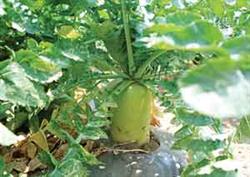
Radish
Radish and carrot are both root vegetables. They are eaten for their enlarged fleshy roots. For every 1000 kg of radish produced, it is necessary to absorb 2.1-3.1 kg of nitrogen (N), 0.8-0.9 kg of phosphorus (P2O5), and 3.8-5.6 kg of potassium (K2O) from the soil. The ratio of the three is 1:0.2:0.8, which shows that radish is a potassium-loving crop.
The uptake of nitrogen, phosphorus and potassium by radish varies greatly at different growth stages. Generally, nitrogen uptake is relatively high at the seedling stage, while phosphorus and potassium uptake is relatively low; entering the early stage of fleshy root enlargement, the plant's potassium uptake increases significantly, followed by nitrogen and phosphorus; by the peak stage of fleshy root enlargement, nutrient uptake reaches its peak. During this period, nitrogen uptake accounts for 77.3% of total nitrogen uptake during the whole growth period, phosphorus uptake accounts for 82.9% of total phosphorus uptake, and potassium uptake accounts for 76.6% of total potassium uptake. Therefore, ensuring adequate nutrition during this period is the key to a high yield of radish.
(1) Base fertilizer. Generally, apply more than 2000 kg of decomposed organic fertilizer per mu, combined with the application of phosphorus and potassium chemical fertilizers.
(2) Topdressing. On the basis of appropriate topdressing in the early stage, when the radish begins to break through the soil, apply 8-10 kg of urea per mu combined with irrigation. Nitrogen fertilizer should not be applied too much or too late, and should be applied as much as possible before the peak stage of radish enlargement. If applied too much or too late, it is easy to cause the fleshy root to crack or produce a bitter taste, affecting the quality of the radish. During the peak stage of radish enlargement, additional potassium fertilizer is also needed. In addition, attention should be paid to nutrient balance. It has been reported that applying a three-element compound fertilizer can increase radish yield compared with applying urea alone, and can also improve its quality.