What are the key cultivation techniques for white radish?
Choosing suitable soil For radish cultivation, the previous crop should be one that consumes little fertilizer, leaves behind plenty of organic matter, and is free of the same diseases and pests. Cruciferous vegetables must be avoided as the previous crop, otherwise diseases are likely to occur. Radish has fairly broad adaptability to sandy loam, but to obtain high yields and quality produce, it is still best to use deep, loose...
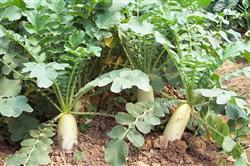
Choosing suitable soil
For radish cultivation, the previous crop should be one that consumes little fertilizer, leaves behind plenty of organic matter, and is free of the same diseases and pests. Cruciferous vegetables must be avoided as the previous crop, otherwise diseases are likely to occur. Radish has fairly broad adaptability to sandy loam, but to obtain high yields and quality produce, deep, loose, well-drained and relatively fertile sandy loam is still preferable. Only when grown in suitable soil can the fleshy root fully expand, take on a regular shape, have a smooth skin and attractive color, and thus be marketable.
The plot requires deep plowing
Leveling and uniform fertilization are required, as this promotes an increase in available nutrients and beneficial microorganisms in the soil, and makes it loose and aerated, which helps the absorbing roots take up nutrients and water, thereby rapidly expanding leaf area and accelerating the expansion of the fleshy root. Apply 75 kg of NPK compound fertilizer per mu as a base fertilizer. Then carry out soil disinfection and sterilization and control of underground pests. For the fungicide, use a 50% carbendazim 600-fold solution or a 70% thiophanate-methyl 800-1000-fold solution as a spray; for the insecticide, a 48% chlorpyrifos emulsifiable concentrate 800-1000-fold solution may be used as a spray.
Sowing
The quality of radish seeds has a great influence on the growth and yield of the radish plants. To achieve uniform emergence, a complete stand and strong seedlings, the seeds should be carefully selected, using only plump, sound seeds and discarding shriveled, broken and moldy ones. The sowing rate must be determined according to seed quality, soil texture, climate and sowing method. Autumn radish is mostly sown by dibbling or drilling. The amount of seed used is determined by the desired plant spacing; for dibbling, the hole spacing is 25-30 cm, with 4-5 seeds per hole, and the seeds should be spread out within the hole to avoid crowding after emergence, which would affect seedling quality.
Field management must keep up in a timely manner
After the seedlings emerge, they grow rapidly, so thinning must be done in time to prevent crowding, shading and excessive vegetative growth. Seedlings should be fixed early, with thinning carried out in stages and final thinning at the proper time, to ensure a complete and strong stand. Generally, thinning is done 2-3 times, removing weak, deformed and pest- or disease-damaged seedlings.
Reasonable watering
Watering is mainly determined by the growth characteristics of radish, the water requirements at each growth stage, and climatic conditions and soil conditions. After sowing, if the weather is dry, water immediately once, and water again when emergence begins, keeping the soil surface moist, ensuring uniform emergence and reducing the occurrence of viral disease. If there is heavy rain, drainage must be carried out in time to prevent seedling death.
Scientific topdressing
Autumn radish belongs to the medium-to-large radish varieties and has a relatively long growth period. On the basis of applying sufficient base fertilizer before sowing, topdressing should be applied appropriately; especially on plots with low soil fertility and insufficient base fertilizer, topdressing can significantly increase yield. Fertilization should use nitrogen fertilizer diluted with water or applied as clear manure water. After the radish "breaks its belly," it enters the peak leaf growth stage, namely the rosette stage; to promote leaf area expansion, a quick-acting nitrogen fertilizer should also be applied once; when it enters the peak fleshy root expansion stage, a compound fertilizer should be applied as topdressing. This helps the fleshy root expand. And 20 days before harvest, spray 0.2% potassium dihydrogen phosphate once a week for 2 consecutive sprays as foliar topdressing, which has a good effect on increasing yield and improving fleshy root quality.
Scientific intertillage, weed control and pest control
Radish requires repeated intertillage and loosening of the soil during the growth period, especially at the seedling stage, when the temperature is relatively higher, there is more rain, and weeds grow rapidly, so intertillage and weeding must be done frequently. In high-ridge cultivation, the soil on the ridge is easily washed away by rain, so hilling should be combined with intertillage. For long, exposed-shoulder radish varieties, because the root neck is long, thin and weak, it often bends and lodges easily, so soil should be hilled up in the early growth stage to expand the root area. This prevents lodging from causing curved radish later. By the late rosette stage, the leaves have closed the rows, so intertillage is stopped and weed control is done only by hand pulling.
The main pests and diseases of radish are aphids and soft rot. Per mu, use 10 million units of 12% agricultural streptomycin sulfate wettable powder plus 50-75 kg of water, or spray with a 57.6% chlorothalonil dry granule 1000-1200-fold solution, combined with root drenching. To control aphids, imidacloprid-type products can be diluted with water and sprayed.
Timely harvest
The harvest time of autumn radish depends on the variety and the marketing period. Harvesting too early gives low yield and a hard, tasteless root; harvesting too late exposes the fleshy root to freezing or causes hollowing, deteriorating quality and leading to hollow heart. When the root diameter has expanded to 8-10 cm and the length is 25-30 cm, harvesting is more appropriate.