Key Technical Points for Spring Sowing and Cultivation Management of Carrots
The growing temperature range for radishes is 6 to 25°C. Among the winter-spring radish varieties currently in wider use are Korean New White Jade Spring, White Light Spring White Jade, and others. For the soil, choose a sandy loam that is loose in texture, fertile, and well aerated. Before sowing, apply sufficient fully decomposed organic fertilizer and compound fertilizer; generally apply 45,000 to... of organic fertilizer per hectare.
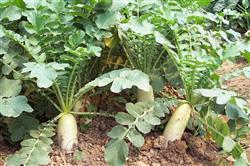 1. Determine the suitable sowing date.
Carrots sown too early in spring are prone to bolting, while sowing too late places the period of fleshy root expansion during high temperatures above 25°C, producing large numbers of deformed roots. The suitable temperature for carrot fleshy root expansion is 18-25°C. Based on production experience, provided that bolt-resistant spring-sowing varieties are selected, sowing can be done when the daily average temperature is 10°C and the nighttime average temperature is 7°C. In South China, sowing can be done in early March.
2. Land preparation, fertilization, seed soaking, and germination promotion.
Carrots are root vegetables, so choose a sandy loam or loam with deep soil layers, fertile soil, and good irrigation and drainage. Before sowing, plow deep and harrow fine, with a tillage depth of no less than 25 cm. In conjunction with plowing and turning, apply 5,000 kg of decomposed farmyard manure per mu, and 15 kg of phosphorus and potassium fertilizer and quick-acting nitrogen fertilizer. Carrot seeds do not readily absorb water or allow air passage, and coupled with low soil temperatures in spring sowing, this causes seeds to germinate and emerge slowly. To promote early germination and emergence, soak the seeds before sowing to promote germination. The method is to soak the seeds in warm water at 30-35°C for 3-4 hours, then remove them, place them in a wet towel or bag to keep them moist, and keep them at 25-30°C to promote germination for 3-4 days, stirring and rinsing regularly. Once 80%-90% of the seeds have split and shown white, they can be mixed with wet sand and sown. After sowing, cover evenly with a thin layer of soil and cover with plastic film, or straw or grass can be used instead.
3. Field management.
After sowing, keep the soil moist. Water immediately, or water after [blocked], to create conditions favorable for seed germination and emergence. After the seedlings have all emerged, remove the covering on a windless morning. Thin the seedlings twice during the seedling stage. The first thinning is carried out when there are 1-2 true leaves, removing inferior, weak, and overly dense seedlings; the second is carried out when there are 3-4 true leaves. After the second thinning, the seedlings are finalized, with a plant spacing of 9 cm and a row spacing of 15-18 cm. Cultivation and weeding are key to a high carrot yield. In addition, when cultivating, take care to hill up soil to prevent the top of the fleshy root from being exposed above the ground and forming a green shoulder.
To achieve a high carrot yield, water and apply topdressing 2-3 times throughout the growing period. The first time is 5-7 days after the seedlings are finalized, applying 3 kg of ammonium sulfate and 3 kg each of phosphorus and potassium fertilizer per mu along with watering. The second time is at the 8-9 true leaf stage, the early stage of fleshy root expansion, which is the period of greatest water and fertilizer demand, applying 7.5 kg of ammonium sulfate and 3.5 kg each of phosphorus and potassium fertilizer per mu along with watering.
4. Harvest in stages at the appropriate time.
Most spring-sown carrots in Guangdong are sown in early March and generally harvested in early June. When mature, the leaves stop growing, no new leaves appear, and the lower leaves turn yellow. Harvesting too early or too late will both affect the marketable quality of the carrots, thereby affecting yield. If a 0-3°C cold storage facility is available, store them there after harvest to supply the market throughout the summer.