How is integrated control of lotus root diseases carried out?
I. Lotus root brown spot disease A common disease of lotus leaves, producing light brown lesions on the leaves, causing localized drying of the affected leaves. Control: Reasonable close planting to ensure ventilation and light penetration in the lotus field; appropriately increase the application of phosphorus and potassium fertilizers to improve plant resistance, and promptly remove diseased plant residues. At the early stage of the disease, use 25% carbendazim 600x solution, or 75% chlorothalonil...
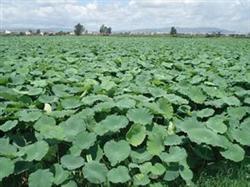 Lotus root is a high-yield, high-efficiency aquatic economic crop and a vegetable variety commonly eaten by the general public. It is widely cultivated in various regions. With the adjustment of industrial structure in various places, its cultivation area has shown a trend of continuous expansion. In recent years, lotus root diseases have become increasingly severe and have become a major obstacle to the development of lotus root production.
I. Common diseases of lotus root
1. Lotus root rot disease, also known as black root disease or lotus root plague. It is the number one disease in lotus root production. It is generally prone to occur in old lotus fields with shallow plough layers and shallow water and in continuous cropping fields, affecting lotus root formation and reducing yield. It is a lotus root disease caused by infection with the corm-like Fusarium fungus, mainly damaging underground stems, aboveground leaves and leaf surfaces. The leaves produced from diseased stems are light green in color, beginning to dry up and turn brown from the leaf margins, and the petioles finally die. The pathogen mostly invades from wounds, absorbing roots or growing points, and the pathogen spreads with flowing water irrigation.
2. Lotus root leaf blight is the second major disease of lotus root. The pathogen is a pathogenic fungus of the genus Sphaerotheca. It mainly damages lotus leaves. Light yellow lesions first appear at the edges of lotus leaves, then gradually spread toward the middle of the leaf, becoming yellow-brown, and finally spread from the mesophyll to the leaf veins until the entire leaf dies. High temperature and abundant rain favor disease occurrence. Insufficient fertility in the lotus field makes the disease severe.
3. Lotus root leaf spot mainly damages leaves and can sometimes also occur on petioles. It is caused by a pathogenic fungus of the genus Isaria.
II. Integrated control of lotus root diseases
1. Implement 2-3 year crop rotation. In particular, paddy-upland rotation plays an important role in reducing diseases.
2. Select disease-free seed lotus roots for planting. Seed lotus roots carrying pathogens are the main source of infection for rot disease. To prevent this disease, the key is to select healthy plants from disease-free lotus fields as seed lotus roots and eliminate the source of infection. Before planting lotus roots, spray the seed lotus roots with 50% carbendazim or thiophanate-methyl 800x solution, or 75% chlorothalonil wettable powder 800x solution, then cover and seal them with plastic film to sweat the seeds for 24 hours, and sow after drying.
3. Remove diseased plants. Thoroughly remove diseased plants and diseased residues from affected lotus fields, and deep bury or centrally burn them. Before planting, apply 50-100 kg of quicklime per mu, which both sterilizes and cleans the field and accelerates the decomposition of organic fertilizer.
4. Reasonable fertilization. Base fertilizer should be mainly organic fertilizer, and the fertilizer must be fully decomposed. For soil with strong acidity and strong reducing properties, lime should be applied heavily, and lime should be applied early and in larger amounts. During the growth period, pay attention to the combined application of nitrogen and phosphate fertilizers. Where conditions permit, increase the application of silicon fertilizer, advocate supplementary application of boron, zinc, molybdenum and other microfertilizers, and do not apply chemical nitrogen fertilizer alone, so as to improve the disease resistance of the plants.
5. Scientific water management. During the disease period, irrigate with deep water to lower soil temperature and inhibit pathogen reproduction. Lotus fields kept for seed should maintain deep water soaking every day; do not drain the water or carry out winter ploughing and sun-drying of the soil. Non-seed fields should, after harvesting lotus seeds, all cut the lotus stems and plough or dig lotus roots, and it is best to plant a winter crop. Even if no winter crop is planted, the field should still be ploughed and irrigated to soak the field, reducing pathogen carryover in the soil and diseased residues.
6. Timely pesticide control. At the early stage of the disease, use 50% carbendazim wettable powder 600-800x solution, or 50% thiophanate wettable powder 800-1000x solution, or use 50% carbendazim wettable powder 600x solution plus 75% chlorothalonil 600x solution for spraying. The above mixed powder 500 g can also be mixed with fine soil 25-30 kg, piled and sealed for 3-4 hours, then scattered into the shallow water layer under the lotus root crowns. After 2-3 days, use the above mixed agent 600x solution or 70% thiophanate-methyl 800x solution, or carbendazim 200x solution mixed with "402" 4000x solution, and spray on leaves or petioles, spraying continuously 2-3 times, which can effectively reduce or control the spread of this disease.