Detailed Explanation of Key Points for Early-Maturing Lotus Root Cultivation Techniques
Based on their adaptability to water levels, lotus roots can be divided into two ecological types: shallow-water lotus root and deep-water lotus root. Shallow-water lotus root is suitable for water levels of 10-20 cm, with a maximum water depth tolerance of 30-50 cm. Deep-water lotus root is suitable for water levels of 30-50 cm, with a maximum water depth tolerance of 1-1.2 m. The general principle for water layer management in shallow-water lotus root is: shallow at the front, deep in the middle, ...
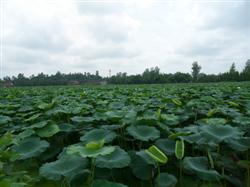 After introducing hybrid lotus root and extra-early-maturing lotus root, and through several years of trial planting and demonstration, a new technique of protected cultivation of lotus root using film small arched sheds was developed. This technique allows earlier planting and earlier marketing, with harvest and marketing from late June to early July. After the lotus root harvest, late rice can be planted, and after the late rice harvest, winter vegetables can be planted in time. Through winter vegetable cultivation, the soil is fertilized and matured, and lotus root can be planted again the following year. This forms a cultivation pattern of lotus root - late rice - winter vegetables, significantly improving economic benefits. The technique of protected cultivation of lotus root using film small arched sheds is introduced as follows:
1. Select Good Fields and Fertilize the Soil
Lotus root prefers fertile soil. Generally, it is advisable to choose paddy fields with clay loam soil that is rich in organic matter, has deep and loose soil layers, and has strong water and fertilizer retention capacity. For paddy fields preparing to plant lotus root the following year, after the late rice harvest, apply 1500 kg of livestock and poultry manure per mu and plow. Plant dwarf disease-resistant green Chinese cabbage. At transplanting, water with dilute human manure. After the plants survive and turn green, carry out intertillage, and apply 15 kg of ammonium bicarbonate dissolved in 1000 kg of water or 1000 kg of dilute human manure per mu. After that, multiple topdressings should be applied. Through winter vegetable cultivation, the soil is fertilized, making the soil loose with high organic matter content, to meet the fertilizer demands of early lotus root.
2. Plant at the Right Time
The suitable daily average temperature for planting early lotus root is above 12°C. The lotus root field is covered with a film small arched shed, and the sowing period is from late February to early March. When the temperature is suitable, seize calm sunny days to plant and cover with film at the same time. Select seed lotus roots that are whole, free from mildew and rot, free from breakage or injury, thick and uniform, with fine nodes. The planting density and seed quantity for early lotus root are higher than conventional planting. The row spacing is 160 cm, the plant spacing is 100 cm, and 400-450 hills are planted per mu, with 3 roots per hill. The number of lotus root heads per mu is 1200-1300, requiring 300-400 kg of seed lotus root. When planting, the lotus root heads in the edge rows should face inward to prevent the lotus rhizomes from extending beyond the ridge. The positions of seed lotus roots in each row should alternate with each other, arranged in a plum-blossom pattern. Use the horizontal shallow-slanting planting method, which helps the lotus root seedlings receive heat and promotes sprouting.
3. Apply Sufficient Base Fertilizer and Skillfully Apply Topdressing
For base fertilizer, generally apply 2000 kg of decomposed barnyard manure, 15 kg of potassium chloride, and 50 kg of phosphate fertilizer per mu. Phosphate fertilizer can be applied as seed fertilizer beside the hills. 2-3 days after removing the film, apply 15 kg of ammonium bicarbonate or 1750 kg of dilute human manure per mu as weaning fertilizer. After that, every 15 days, apply 7.5 kg of urea or 1750 kg of human manure per mu as topdressing until lotus root formation stops. When topdressing, appropriately drain the field water shallow, and it is best to broadcast on calm sunny days around the lotus root clumps. Prevent fertilizer from falling on the lotus leaves; if fertilizer falls on the lotus leaves, rinse with clean water. When applying farmyard manure, tread it into the mud to help raise soil temperature.
4. Field Management
4.1 Water Management? The field water level should go from shallow to deep, then from deep to shallow: at the initial stage of planting, maintain a shallow water depth of 3-5 cm on the field surface to raise soil temperature and promote sprouting. After vigorous growth begins, gradually deepen the water layer to 10-15 cm. During the lotus root formation period, lower it again to 3-5 cm.
4.2 Shed Film Management? At the initial stage of planting, the temperature is relatively low, so the shed film should be covered tightly and securely. The direction of the shed film should be parallel to the usual wind direction to prevent strong winds from blowing the shed film over and causing the lotus root seedlings to freeze. Around Qingming, the temperature gradually rises. When the temperature rises above 20°C, open both ends of the film during the day for ventilation to prevent burning the buds and leaves, and cover the film at night to keep warm. As the temperature continues to rise, increase ventilation for hardening the seedlings. When the standing leaves emerge, choose a calm sunny day and completely remove the film after 4 p.m. Before removing the film, irrigate with deep water to protect the seedlings and prevent excessive water loss. 2-3 days after removing the film, lower the water level, pull out weeds, and promptly apply weaning fertilizer. For lotus rhizomes near the field ridge, turn the shoots at noon when the stems and leaves are soft.
4.3 Remove Old Leaves and Bend Flowers? After standing leaves cover the field, ventilation becomes poor, light is insufficient, and assimilation decreases. At this time, the senescent leaves can be removed. To avoid nutrient consumption, after budding, the flower stalks can be bent but not broken, to prevent rainwater from entering.
4.4 Pest and Disease Control?? Common pests include aphids and tobacco cutworms, which can be controlled by spraying with 40% dimethoate emulsifiable concentrate at 1500 times dilution and 40% fenvalerate at 6000-7000 times dilution, respectively. Common diseases include brown blight, black root rot, and soft rot. The control methods are: select disease-free seed lotus root, avoid continuous cropping as much as possible, apply fully decomposed farmyard manure, and broadcast 75-100 kg of quicklime per mu. When irrigating, be careful not to let field water that has just been treated with herbicide flow in, to avoid phytotoxicity.
5. Harvest and Seed Retention
5.1 Harvest Early lotus root can be dug for tender fresh lotus root at the end of June. Because hybrid lotus root enters the soil shallowly, when digging lotus root, you can feel for the lotus root by hand in the water. When feeling for lotus root, you can choose the large ones and leave the small ones, or feel out the entire patch. All should be dug out before transplanting late rice. When digging lotus root, cut the leaf stalks with a knife and tread them into the field as fertilizer. Lotus leaves can be picked, sun-dried, and stored for other uses.
5.2 Seed Retention Generally, about 166.7 sq m of seed retention field is needed per mu. Seed lotus root can overwinter in the field. During overwintering, keep the soil moist to prevent frost damage. By the time of planting the following year, dig and plant as you go. Surplus seed lotus root can be supplied to the market.