Detailed Explanation of Key Techniques for High-Yield Yam Cultivation
To achieve high yields of yam, selecting good varieties is crucial. Yam varieties can be divided by use into edible yams, medicinal yams, and dual-purpose (medicinal and edible) yams. By shape, they can be divided into long yams, flat yams, and round yams. Long yams are long and columnar; flat yams resemble a foot sole, fan-shaped, narrow at the top and wide at the bottom; round yams are short and round or irregularly clump-shaped. ...
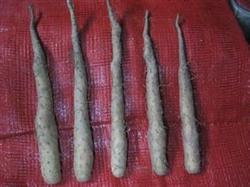 Yam, also known as Chinese yam, wild yam, or Huaishan. Yam is a perennial twining herb with a cylindrical underground stem that is thick and fleshy, rich in starch, and can be used to make starch; in tropical regions it is often used as a food crop. Yam has a distinctive flavor, is a prized vegetable, a tonic food, and also a good raw material for brewing wine. The high-yield cultivation techniques for yam are introduced as follows:
Site selection and bed preparation: Yam is a vegetable whose product is the underground fleshy tuber, with fine fibrous roots, so it has relatively strict requirements for soil physical and chemical properties. Generally, it requires deep soil layers, good aeration, rich organic matter, and good drainage, and should be planted in sandy soil or sandy loam. The bed height should be more than 60 cm, and the bed surface 80 cm.
Digging holes and applying sufficient base fertilizer: This is one of the key technical measures. After the bed is prepared, choose a steel rod 1.5 m long and 2 cm in diameter, and while arranging it along the edge of the bed, dig holes while shaking the steel rod to make deep holes 10 cm in diameter (giving the yam tuber a loose growing environment so it grows long and straight). Combine this with applying decomposed organic fertilizer, such as high-quality barnyard manure, human excrement, chicken manure, and miscellaneous compost, at 2000 kg per mu.
Timely sowing: In mid-to-late March, choose a sunny or overcast day (rainy days are not suitable), cut the yam seed into sections 5 cm each, place one section upright in each hole, and do not place it upside down (note to keep fertilizer and seed separated to prevent seed rot), then cover with soil 5-8 cm. Field management: Yam is propagated by underground tubers. After germination, it goes through the germination stage, seedling stage, vine growth stage, and tuber expansion stage. Before the vine growth stage, stem and leaf growth is dominant; after budding, it enters the tuber expansion stage. In the early stage, stems and leaves grow vigorously at the same time as the tubers; in the later stage, tuber growth is dominant, and at this time the dry matter accumulated in the tubers accounts for more than 85% of the total dry matter. In the seedling stage, to promote stem and leaf growth, the nitrogen fertilizer amount can account for 1/2 of the total for the whole growth period, and some potassium fertilizer should also be applied. In the vine growth stage and tuber expansion stage, additional phosphorus and potassium fertilizer and the remaining nitrogen fertilizer should be applied to promote tuber growth, by opening shallow furrows on both sides of the yam planting row for fertilization.
Timely harvesting: The yam harvest period is very long, lasting from early September until the Spring Festival of the following year. To obtain better economic benefits, harvesting can begin in early September.