Key Cultivation and Management Techniques for Fruit-Type Cucumbers in Spring Season
Land preparation, fertilization, and transplanting. Fruit-type cucumbers produce a large number of fruits and require an ample nutrient supply. It is advisable to select loam soil with a deep soil layer, high organic matter content, and good water and fertilizer retention for planting. Before transplanting, apply 5000 kg of decomposed organic fertilizer per 667 sq m, along with 30 kg of superphosphate, 200 kg of cake fertilizer, and 5...
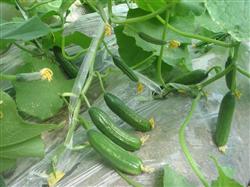
Land preparation, fertilization, and transplanting. Fruit-type cucumbers produce a large number of fruits and require an ample nutrient supply. It is advisable to select loam soil with a deep soil layer, high organic matter content, and good water and fertilizer retention for planting. Before transplanting, apply 5000 kg of decomposed organic fertilizer per 667 sq m, along with 30 kg of superphosphate, 200 kg of cake fertilizer, and 50 kg of plant ash. Deeply plow and mix evenly, rake level and form beds, making raised beds 20-30 cm high, and cover with plastic mulch. If conditions allow, it is best to install drip irrigation facilities. Transplant in mid-February when the seedlings have 3-4 true leaves. When transplanting, dig holes according to the plant spacing, plant the seedlings, cover with a small amount of soil, then pour water into the holes, and close the holes after the water has infiltrated.
Field management. Temperature management. Within 1 week after transplanting, the greenhouse should be kept appropriately closed, maintaining 25°C-30°C during the day and 18°C-20°C at night, and not ventilated above 35°C, to promote seedling recovery. After seedling recovery, ventilation may be appropriately increased to lower the temperature, generally maintaining 22°C-25°C during the day and 16°C-18°C at night. After entering the full fruiting period, the daytime temperature should be maintained at 25°C-30°C and the nighttime temperature at 15°C-17°C. Fertilizer and water management. Seven days after transplanting, water should be applied for seedling recovery. After watering for seedling recovery and before the first fruit sets, watering should be controlled, generally with no watering; after the first fruit sets, a small amount of water can be applied every 3-5 days, and flood irrigation must be strictly avoided. Apply fertilizer with every other watering, applying 10-15 kg of compound fertilizer per 667 sq m. During the growing period, foliar fertilizer should also be applied 3-4 times, generally using 0.2% monopotassium phosphate combined with trace elements and sprayed together with pesticide application. Plant adjustment. After transplanting, attention should be paid to removing side branches growing from the rootstock and side branches of the plant. Generally, single-vine pruning is carried out, and side vines are removed. Fruit-type cucumbers have strong female characteristics and produce female flowers at low nodes. Generally, the female flowers produced on the first five nodes should all be removed, and fruit setting should begin from the sixth node to ensure yield. When the seedlings grow to more than 25 cm, vines should be trained and hung in time, generally using silver-gray plastic hanging strings for vine hanging. In the middle section, 1-2 fruits can be retained per node, and excess female flowers should be removed. Generally, at most 2 fruits are retained per node, and excess female flowers should be removed in time. In the middle and late stages of fruit-type cucumber growth, the lower leaves begin to age and lose photosynthetic capacity. Old leaves and diseased leaves should be removed in time to improve ventilation and light penetration and reduce the occurrence of pests and diseases.
Pest and disease control. The pests and diseases of fruit-type cucumbers are basically the same as those of common cucumbers, and the control methods are also the same. In current production, the more serious diseases are mainly Fusarium wilt, powdery mildew, downy mildew, etc., and the main pests are aphids, beet armyworm, and whitefly. Pest and disease control should follow the principle of prevention first and integrated control.
Timely harvesting. Generally, harvesting can be carried out 6-10 days after the female flowers open, when the fruit is 12-18 cm long and 2-2.5 cm in transverse diameter. When harvesting, use scissors to cut off the fruit stalk to prevent damage to the vines, and be careful to handle them gently.