What are the integrated control methods for wheat take-all disease?
Wheat take-all is a typical root disease, capable of infecting wheat from sowing through to harvest. The main sites of infection are the wheat roots and the 1st to 2nd nodes of the stem base. After infection by the pathogen, the roots turn black and rot, losing their ability to absorb water and nutrients, which causes the above-ground parts to dry up and die, resulting in white heads. 1. ...
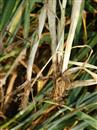
Wheat take-all is a typical root disease, capable of infecting wheat from sowing through to harvest. The main sites of infection are the wheat roots and the 1st to 2nd nodes of the stem base. After infection by the pathogen, the roots turn black and rot, losing their ability to absorb water and nutrients, which causes the above-ground parts to dry up and die, resulting in white heads.
1. Field symptoms: The symptoms of this disease are not obvious at the wheat seedling stage, but become obvious at the grain-filling stage. The above-ground wheat plants die in clumps or patches. When diseased plants are pulled up, the roots can be seen to be short and few, blackened and rotting; when the leaf sheaths of the 1st to 2nd nodes at the stem base are peeled off, the stem shows a black plaster-like, developed mycelial layer, and when the field climate is humid, small black dots, namely ascocarps, can be seen on the leaf sheaths. In dry conditions, the roots turn black and the mycelial layer and ascocarps do not form.
2. Transmission routes: Pathogen-carrying diseased residues spread the disease through seeds, soil and manure.
3. Infection cycle: Besides infecting and damaging wheat, it can also infect gramineous crops such as corn and millet and gramineous weeds, but does not show disease symptoms on them. After the wheat harvest, the pathogen overwinters on diseased residues or on other gramineous plants, and after sowing it infects and damages wheat.
4. Conditions for disease occurrence: It is severe in continuous cropping plots and relatively mild under rotation; severe in low-fertility plots and mild in high-fertility plots.
5. Control methods: For this disease, prevention is more important than cure; monitoring should be strengthened and epidemic surveys carried out.
1. Agricultural control: (1) Remove diseased residues and burn them. Reduce and alleviate the pathogen.
(2) Rational rotation. Rotate with non-host crops.
(3) Sow late at the appropriate time. When the soil temperature drops below 12°C, it is unfavorable for the pathogen to invade.
(4) Apply more organic fertilizer and more phosphorus and potassium fertilizer.
2. Chemical control: (1) Soil treatment. Use 2.5 kg of carbendazim or thiophanate-methyl per mu, mix with 15 kg of soil, and broadcast it before plowing; in severely affected areas, broadcast more.
(2) Seed treatment. Use agents for controlling take-all for seed coating or seed dressing. The agents include: diwei dan, Shileshi, and Likexiu.
(3) Early spring control. Before wheat jointing, use Heguoli or triadimefon for root irrigation control.