What are the control methods for waterlogging damage in wheat?
Boron deficiency symptoms in wheat generally appear first in new growth, showing as terminal buds that easily die back, a long flowering duration, sometimes heading and tillering at the same time, and a prolonged growth period; stamens are poorly developed, anthers are thin and small, empty and not dehiscing, not shedding pollen, pollen is scarce or malformed, the ovary swells horizontally, the glumes do not close front and back, and later wither;...
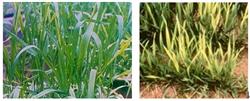 Waterlogging damage in wheat is one of the five major damages in wheat production (waterlogging damage, freezing damage, dry-hot damage, weed damage, and disease and insect damage). In recent years it has been common in Hubei, the Huaibei wheat region, and the Jiangsu hilly wheat region, with varying accumulated occurrences every year. The root system of wheat suffering from waterlogging damage remains in an oxygen-deficient environment for a long time, and the absorption function of the roots weakens, causing the plant to actually suffer from water deficit internally, and in severe cases causing dehydration, wilting, or death; therefore waterlogging damage is also called physiological drought damage. It can be harmed from the seedling stage to the flowering and grain-filling stage. Damage at the seedling stage causes seed and seedling rot, a low seedling survival rate, delayed tillering, an underdeveloped root system, and small yellow seedlings; damage at the jointing and heading stage makes the top three functional leaves 20%, 30%, and 36% shorter respectively than those of healthy plants, and reduces effective spikes by 40%; damage at the flowering and grain-filling stage causes early senescence of functional leaves, fewer grains per spike, lower 1000-grain weight, premature maturity under high temperature and high humidity, and in severe cases blight and death. In production, waterlogging damage occurring in the middle and late stages is heavier than in the early stage, and among these, waterlogging damage occurring at the jointing and booting stage causes the heaviest losses; during this period the damage results in fewer effective spikes, fewer grains per spike, lower grain weight, and reduced yield.
In the Huaibei wheat region, although the incidence of waterlogging damage is not very high, its harm cannot be ignored. In the past 44 years, the Xuzhou area has had 13 years of waterlogging damage of varying degrees, accounting for 29.5%, but in the past 10 years waterlogging damage has increased, especially in 1989, 1990, and 1991, when continuous overcast and rainy weather occurred for 3 consecutive years, with relatively large rainfall, causing large-scale lodging of wheat, reduced grain weight, mildew and sprouting, and bringing huge losses to wheat production. After autumn sowing in 1996, continuous overcast and rainy weather lasted 10 days, with rainfall reaching 104.4mm, causing most wheat in Tongshan County to suffer waterlogging damage and severe losses.
The main causes of waterlogging damage. From late October to early November 1996, rainfall over nearly 10 days was 104mm, an increase of 79.7mm over the same period in a normal year and an increase of 90.8mm over the same period in 1997. Excessive rainwater caused the water content of the plough layer to be too high, the plough layer water to be saturated, oxygen to be lacking, and the root system to remain in an oxygen-deficient state for a long time, respiration to be inhibited, vitality to decline, and the ability to absorb water and fertilizer to decrease; moreover, organic matter in the soil under anaerobic conditions produces reducing toxic substances that poison the root system, causing poor root growth and reduced root mass. At this time, nitrogen metabolism in the plant body declines, and the nitrogen content in the functional leaves decreases markedly, causing the plants to have small yellow seedlings or become stunted seedlings. Second, the groundwater level is high, especially in wheat fields close to rivers and lakes or low-lying irrigated wheat, where the groundwater level is high, harming the downward growth of wheat seedling roots. Measurements showed that waterlogged wheat fields had only 2.98 secondary roots per wheat plant, 1.54 fewer than the control, and in severe cases almost no secondary roots. When affected by waterlogging at the seedling stage, although the plants can grow slowly during the overwintering period, by the greening stage the secondary roots per plant are 2-3 fewer than normal, causing small seedlings, few leaves, yellow color, and stunted seedlings; by the greening stage, the stems and tillers per plant and the total seedling number are also fewer than normal; by the jointing stage, the stems and tillers per plant reach 5.7, large tillers with more than three leaves are insufficient, 0626 fewer than normal, and tiller quality is relatively low, resulting in a final effective spike number that is on the low side. Third, the three ditches are not dredged and drainage and irrigation facilities are poor, so surface water cannot be drained away, subsurface water cannot be filtered out, and the furrows and beds are not unobstructed, causing waterlogging damage to occur. Fourth, the layout is unreasonable, especially for irrigated wheat or so-called paddy-field wheat, where contiguous planting has not been carried out; in some cases wheat is interplanted in winter-irrigated fields, so surface water in the wheat field cannot be drained away, and accumulated water over time becomes a disaster, with severe blight and dead seedlings appearing.