Detailed key points for water spinach cultivation, teaching you to grow water spinach well
Water spinach, whose scientific name is swamp cabbage (Ipomoea aquatica), also known as bamboo-leaf vegetable, vine vegetable, and tung choy, is an annual or perennial trailing plant of the Convolvulaceae family. Water spinach is eaten for its tender stems and leaves. Water spinach has a long harvest period and is a leafy vegetable that grows in summer, which can make up for the market structure in Liaoning in summer where leafy vegetables are scarce and fruiting vegetables are abundant. The branches that water spinach sends out from the leaf axils to produce tender shoots can...
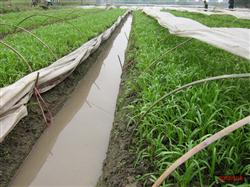
Water spinach, whose scientific name is swamp cabbage (Ipomoea aquatica), also known as bamboo-leaf vegetable, vine vegetable, and tung choy, is an annual or perennial trailing plant of the Convolvulaceae family. Water spinach is eaten for its tender stems and leaves. Water spinach has a long harvest period and is a leafy vegetable that grows in summer, which can make up for the market structure in Liaoning in summer where leafy vegetables are scarce and fruiting vegetables are abundant. Water spinach has a very strong branching ability from the leaf axils to produce tender shoots, can be harvested many times, and is not restricted by high temperature or heavy rain.
I. Botanical characteristics and cultivation features. Water spinach has a fibrous root system that is shallow and has strong regeneration ability; the stem nodes are short, flat-round or nearly round, hollow, and dark green to light green. The cotyledons are opposite, horseshoe-shaped; the true leaves are alternate, long ovate, with the basal leaves heart-shaped or lanceolate, entire, and the leaf surface smooth, dark green or light green. The leaves are 13-17 cm long and 8-10 cm wide, and the petioles are 12-15 cm long, hollow and concave. The seeds are nearly round, with a thick coat, dark brown, and a 1000-grain weight of 32-37 grams. Water spinach is propagated by seeds or tender stems.
Water spinach likes a high-temperature and humid environment. Seed germination requires above 15°C, and the suitable temperature for vine and leaf growth is 25-30°C. When the temperature is higher, vine and leaf growth is more vigorous and the harvest interval is shorter. Water spinach can tolerate high temperatures of 35-40°C; below 15°C vine and leaf growth is slow, and below 10°C vine and leaf growth stops. It is not tolerant of frost, and the stems and leaves die as soon as they encounter frost. Water spinach likes relatively high air humidity and moist soil; when the environment is too dry, the vines have more fiber and the edible quality decreases. Water spinach also likes sufficient sunlight, but it also has a relatively strong adaptability to close planting. Water spinach does best in relatively clayey soil with strong water and fertilizer retention; it has a large fertilizer requirement and strong fertilizer tolerance, especially a relatively large demand for nitrogen fertilizer.
II. Varieties. (1) White-flowered type: the leaves are long heart-shaped, the stems and leaves are thick and light green, the flowers are white, the texture is tender, and the quality is good. Examples include Daguqing and Dajibai. (2) Purple-flowered type: the stems and flowers are tinged with light purple, with more fiber and poorer quality, but strong stress resistance. (3) Ji'an large-leaf swamp cabbage: suitable for cultivation in loam or clay soil, likes nitrogen fertilizer, has luxuriant stems and leaves, hollow and jointed stems, and large leaves; it has high yield and good quality, and strong adaptability.
III. Key cultivation points. The yield of water spinach depends on the number of harvests and the weight of each harvest, and increasing the number of harvests and the amount harvested each time mainly depends on the 3 key links of "planting early, fertilizing more, and harvesting frequently."
1. Site selection: water spinach is suitable for moist soil rich in humus; it has strong branching, well-developed adventitious roots, rapid growth, high planting density, many harvests, high yield, and fertilizer tolerance. Therefore, fields that face the sun, are fertile, and have a water source should be selected for planting. Cultivation in protected facilities gives even better results.
2. Sowing: in the central Liaoning region, open-field sowing is generally done in mid-April, using drilling or dibbling, with a seeding rate of 15 kg per mu. The sowing period for protected cultivation can also be advanced accordingly.
3. Field management: from the cotyledon stage to the 4-5 leaf seedling stage, the suitable temperature for water spinach is 20-25°C. The suitable temperature during the stem and leaf growth period is 25-35°C, and it does not have strict requirements for light conditions. It has a very large demand for water and fertilizer; in addition to applying sufficient base fertilizer, a large amount of topdressing is also needed. Apply topdressing 1-2 times after each harvest; the concentration of topdressing should be light first and then strong, mainly nitrogen fertilizer. Both drought and fertilizer deficiency will affect yield and quality. For harvesting water spinach, if it is a one-time harvest, thinning can be done when the plant height is 12-15 cm. If it is harvested multiple times, when the plant height is 18-21 cm, seedlings can be pulled and thinned in combination with final thinning for market, with a plant spacing of 12-15 cm; the remaining seedlings can be harvested multiple times for market. When the plant height is 33 cm, begin the 1st harvest, leaving two stem nodes at the stem base. For the 2nd harvest, pick the 2nd node left at the stem base. For the 3rd harvest, pick the 1st stem left at the stem base, so as to achieve new sprouting from the stem base. In this way, the stems and vines harvested afterward can remain thick and strong. When harvesting, pinching by hand is best; if harvesting with a knife or other iron tool, the cut area is prone to rusting and dying.
4. Pest and disease control: water spinach has pests such as diamondback moth, red spider mite, aphids, and leaf roller, which should be controlled in time. Among diseases, white rust is the most serious and can be controlled by spraying 1:1:200 Bordeaux mixture, preferably with an interval of 10 days each time.