Detailed Explanation of the Key Technical Points for Water Spinach Cultivation and Management
Water spinach, also known as bamboo-leaf vegetable, tongxin cai, weng cai, tong cai or vine vegetable, is a fast-growing leafy green vegetable that has been actively introduced in various regions in recent years. Its main management techniques are as follows: (1) Raising seedlings. The seed coat of water spinach is relatively thin and not hard, and it absorbs water rather quickly, so sowing dry seeds and allowing them to germinate is sufficient. Soaking seeds to promote germination and then sowing. ...
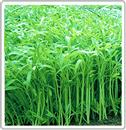
Water spinach, also known as bamboo-leaf vegetable, tongxin cai, weng cai, tong cai or vine vegetable, is a fast-growing leafy green vegetable that has been actively introduced in various regions in recent years. Its main management techniques are as follows:
(1) Raising seedlings. The seed coat of water spinach is relatively thin and not hard, and it absorbs water rather quickly, so sowing dry seeds and allowing them to germinate is sufficient. Soaking seeds to promote germination and then sowing. For example, for each 300 sq m greenhouse, about 2.5 kg of seeds is needed. Soak the seeds in 1/1000 thiophanate-methyl for 30 minutes, then rinse them several times, and then soak them in clean water for 22 hours. After removing and washing them, wrap them in gauze and place them in a 30°C constant-temperature chamber to promote germination; once the seeds split their coats and show white, they can be sown. Before sowing, first fill small gravel to 2/3 of the seedling cups, place them tightly in rows in the seedling trough, about 2000 cups per trough, and add clean water in the trough up to 1/3 of the seedling cups. Sow 3 seeds per seedling cup with the root tips pointing downward, and after sowing cover with a layer of small gravel to slightly cover the seeds. Cover the trough surface with foam boards to maintain humidity in the trough, and water frequently when it is dry. Soaking seeds to promote germination: The seed coat of water spinach seeds is thick and hard. If sown directly, germination will be slow due to low temperature, and if there is prolonged low-temperature rainy weather, it will cause the seeds to rot. Therefore, it is advisable to promote germination. Soak the seeds in warm water at about 30°C for 18-20 hours, then wrap them in gauze and place them in a 30°C germination chamber to promote germination. When 50%-60% of the seeds show white, they can be sown.
(2) Pre-planting preparations. 1. Site selection. When selecting a site, choose a plot with sufficient sunlight and no shading objects around it, and the soil should be loose and breathable, the pH value should be suitable, and the soil moisture should be suitable; it must be suitable for the growth of water spinach. 2. Land preparation and bed making. Before sowing, the land needs to be prepared and beds made. We should deeply plow the soil. If conditions permit, it is best to use a rotary tiller for rotary tillage. A depth of about 10-15 cm is more appropriate. The bed height can be determined by the root depth of water spinach, and a depth of about 10-15 cm is more appropriate. After leveling the soil, make beds, and they should be flat beds running north-south. The width of the bed should be about 1.2 m. The bed ridge height is 0.2 m and the width is 0.3 m, to facilitate later watering and other production management. We can make a partition in the bed about every 0.3 m. Before land preparation, weeds in the land should be cleared in advance, so as to prevent weeds from competing with water spinach seeds for nutrients. 3. Application of base fertilizer. The disinfection method is to broadcast according to the standard of 100 kg of lime per 667 sq m. The broadcasting should be uniform. After broadcasting, deeply plow the soil layer, and the depth of turning the soil should be about 15-20 cm, which is more appropriate. After deeply plowing the soil layer, sun-dry the soil. After sun-drying for 1-2 days, sowing can be carried out.
(3) Planting. Due to the growth of water spinach, planting should be carried out later, and the overly dense parts should be removed so that water spinach can grow better. After removing them, water and apply a little organic fertilizer to supplement nutrients.
(4) Field management. 1. Intertillage and loosening the soil. After direct sowing and emergence, or after transplanting or cutting survives, in combination with intertillage and weeding, apply 1500-2000 kg of 2-3 parts mature human and livestock manure per 666.7 sq m, and thereafter apply water once every 3-5 days. 2. Fertilizer management. About 10-15 days after sowing, when the seedlings grow to 4-6 cm, we can remove the plastic film. If the film is not removed in time, it will affect the development of water spinach seedlings, and may even cause the death of the seedlings. Along with the growth of water spinach seedlings, other small grasses will also grow, and they will compete with water spinach for nutrients, which is not conducive to the growth of water spinach. Therefore, we need to carry out intertillage and weeding. All weeds on the bed surface should be pulled out. When carrying out intertillage treatment on the bed surface, everyone should note that intertillage should not damage the plants, otherwise it is not conducive to plant growth. In later field management, also frequently pay attention to the situation of weeds in the field, and remove weeds promptly when seen, thereby ensuring good growth of water spinach. Water spinach is a crop harvested multiple times, so in addition to applying sufficient base fertilizer, multiple split topdressings must be carried out to obtain high yield. At the seedling stage, 10%-15% dilute human manure and urine can be used for drenching, with a dosage of 1000-1500 kg per mu. When the seedlings have 3-4 true leaves, apply 15-20 kg of compound fertilizer mixed with 2-4 kg of urea. During the harvest period, apply 5-8 kg of compound fertilizer per mu as topdressing after each harvest. 3. Water management. Observe the dry and wet conditions of the soil. If the soil is relatively dry, it should be watered. When watering, the amount of water must be sufficient, and it should be watered thoroughly so that the soil fully absorbs moisture. In later daily management, generally speaking, as long as the soil is seen to be relatively dry, watering can be carried out. Water spinach is a crop harvested multiple times, so in addition to applying sufficient base fertilizer, topdressing must be carried out to obtain high yield. When water spinach seedlings grow to 5-10 cm, the first topdressing can be carried out. When topdressing, it should be applied according to the standard of 500-700 kg of organic fertilizer per 667 sq m. When topdressing, the fertilizer should first be diluted, and then applied along with watering. Fertilization should be uniform. Otherwise, too much fertilizer in one place will burn the plants to death. Before harvesting, generally speaking, carrying out one topdressing is sufficient.
(5) Timely harvesting. Harvesting at the right time is the key to high yield and good quality of water spinach. Generally, water spinach can be harvested when it grows to about 25-35 cm. If not harvested in time, it will both affect the eating quality of water spinach and reduce the yield. Water spinach is a vegetable harvested multiple times. Generally speaking, open-field cultivated water spinach can be harvested continuously until mid-to-late August. When harvesting, all parts of water spinach 4-5 cm above the ground should be harvested. Do not damage the roots of water spinach. After harvesting water spinach, it should be tied into bundles of about 1 kg each. Because water spinach is a crop harvested multiple times, after harvesting, topdressing should also be carried out in time in combination with watering. When topdressing, it should be applied according to the standard of 400-500 kg of organic fertilizer per 667 sq m.
(6) Pest and disease control. The main diseases of water spinach are relatively few, and the main pests are whiteflies and others. It can be sprayed for control with 1000-1500 times dilution of chlorfenapyr and similar products. Spraying should be carried out once when water spinach grows to about 8-10 cm.