What are the control methods for white rust in water spinach?
Because of the high temperature and frequent rain after early summer, water spinach is prone to white rust. Once the disease occurs, it not only reduces the yield but also affects the quality. 1. Symptoms At the early stage of the disease, spots first appear on the upper surface of the leaves as pale yellow to yellow spots, which later gradually turn brown. The spots are relatively large. On the underside of the leaves, white raised blister-like pustules form, nearly round or elliptical to irregular, sometimes coalescing into larger pustules. Later, the pustules rupture and release white sporangia. When the leaves are severely damaged, the spots are dense, the diseased leaves become deformed, and the leaves fall off.
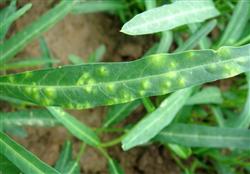
Because of the high temperature and frequent rain after early summer , water spinach is prone to white rust. Once the disease occurs, it not only reduces the yield but also affects the quality.
1. Symptoms
At the early stage of the disease, spots first appear on the upper surface of the leaves as pale yellow to yellow spots, which later gradually turn brown. The spots are relatively large. On the underside of the leaves, white raised blister-like pustules form, nearly round or elliptical to irregular, sometimes coalescing into larger pustules. Later, the pustules rupture and release white sporangia. When the leaves are severely damaged, the spots are dense, the diseased leaves become deformed, and the leaves fall off.
2. Control methods
1. Practice crop rotation. Fields planted with water spinach should be rotated with other vegetable varieties.
2. Use disease-free seeds. Treat the seeds: soak newly purchased seeds in warm water at 50°C for 25 minutes, then cool them before sowing. Before sowing, mix the seeds evenly with 25% metalaxyl at a rate of 300 g per 100 kg of seeds for sterilization, then sow.
3. Strengthen field management. Choose fields with higher terrain, fertile soil, good drainage and irrigation, and good ventilation for planting. Fertilize reasonably, apply more organic fertilizer and phosphorus and potassium fertilizer, and manage water scientifically. If diseased plants are found, pull them out promptly and bury them deeply in a centralized manner. After harvest, thoroughly clean the field, remove diseased branches and residues, and carry out deep plowing to reduce the source of inoculum.
4. Chemical control. Spray for control at the early stage of the disease. The following chemicals can be selected: 25% metalaxyl wettable powder 800-1000 times, 75% chlorothalonil wettable powder 800-1000 times, 65% zineb wettable powder 800-1000 times. Spray once every 7-10 days, for 3-4 consecutive sprays.