Beware of viral disease in rapeseed seedlings: detect and treat early
The characteristics of viral disease occurrence in rapeseed seedlings in seedbeds are as follows: 1. In seedbeds where farmyard manure such as pig manure, cow manure and chicken manure was applied during land preparation, the rapeseed seedlings do not develop the disease. 2. In seedbeds where no farmyard manure was applied and only ammonium bicarbonate was applied, the rapeseed seedlings develop the disease severely. 3. For the same variety and the same fertilizer rate, rapeseed seedlings in seedbeds with high fertility do not develop the disease, while rapeseed seedlings in seedbeds with low fertility do develop the disease.
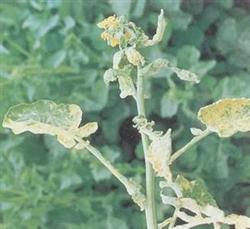
The characteristics of viral disease occurrence in rapeseed seedlings in seedbeds are as follows:
1. In seedbeds where farmyard manure such as pig manure, cow manure and chicken manure was applied during land preparation, the rapeseed seedlings do not develop the disease.
2. In seedbeds where no farmyard manure was applied and only ammonium bicarbonate was applied, the rapeseed seedlings develop the disease severely.
3. For the same variety and the same fertilizer rate, rapeseed seedlings in seedbeds with high fertility do not develop the disease, while rapeseed seedlings in seedbeds with low fertility do develop the disease.
4. During the seedling stage (September 1 to October 1), rapeseed seedlings develop the disease severely when the weather is dry; when there is plenty of rain, the rapeseed seedlings develop the disease only mildly.
Control methods:
1. Select disease-resistant varieties. Generally, Brassica napus (rapeseed) has stronger disease resistance than Brassica juncea and Brassica rapa. In the survey it was found that Qinyou No. 7 did not develop the disease or developed it only very mildly, precisely because it is a Brassica napus variety.
2. When preparing the rapeseed seedbed, strive to apply 2000 kg of farmyard manure such as human and livestock manure per 667 sq m. If pig manure, cow manure and other farmyard manure are unavailable, apply no less than 30 kg of nitrogen-phosphorus-potassium compound fertilizer per 667 sq m, and 500 g of boron fertilizer per 667 sq m. Do not apply ammonium bicarbonate excessively.
3. Under natural field conditions, rapeseed viral disease is mainly transmitted by aphids. Controlling aphids to prevent the disease is the key to controlling rapeseed viral disease. For plots where the disease has already occurred, use insecticides with contact and systemic action to kill aphids, prevent the spread of the virus, and also control cabbage caterpillars.
4. Pay special attention: for plots with severe disease, spray pesticide as early as possible, and after spraying apply urea as a topdressing to promote seedling growth, so as to prevent missing plants when transplanting to the field.