What to do when rice has difficulty heading? Spraying gibberellin can alleviate it
When rice has difficulty heading, or shows the "neck-enclosed" phenomenon, the grains enclosed in the leaf sheath cannot emerge in time for pollination and fertilization, and generally become empty or blighted grains, greatly affecting yield. There are many causes of this phenomenon: in some cases the variety itself is more prone to the neck-enclosed phenomenon, and it becomes more severe under adverse environmental conditions; in others...
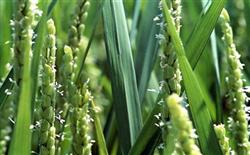
When rice has difficulty heading, or shows the neck-enclosed phenomenon, the grains enclosed in the leaf sheath cannot emerge in time for pollination and fertilization, and generally become empty or blighted grains, greatly affecting yield. There are many causes of this phenomenon: in some cases the variety itself is more prone to the neck-enclosed phenomenon, and it becomes more severe under adverse environmental conditions; in others it is caused by improper pesticide application, for example excessive application of agents such as triadimefon before heading readily causes the neck-enclosed phenomenon, and application of herbicides such as Weiba and Piaoma affects rice growth and can also cause difficulty heading and similar phenomena; adverse environmental conditions such as too-low temperatures at the heading stage can also lead to the neck-enclosed phenomenon in rice.
When rice shows difficulty heading at the heading stage, spraying gibberellin can promote heading, enabling the panicles to emerge in time within 2-3 days and to flower and pollinate normally, which can effectively reduce the empty and blighted grain rate in the lower part of the panicle. Generally, 1-2 grams of 920 (gibberellin formulation) per mu is diluted with 50-60 kg of water and sprayed. If the difficulty heading in the field occurs in spots and patches, take care to spray only these spots and patches when applying, and as far as possible do not spray plants that are heading normally, so as to avoid excessive elongation of the last internode of these rice plants. For spot and patch spraying, the dosage should be determined according to the actual sprayed area, to avoid excessive dosage in local areas. In addition, combined spraying of Chunquan series foliar fertilizers and 0.1% sodium humate salt, 1.5% potassium chloride, 2% urea solution, etc. can enhance the photosynthetic function of leaves and increase the seed-setting rate.