A Complete Analysis of the Harm and Control Measures of Wheat Powdery Mildew
The disease can attack all aboveground organs of the wheat plant, but mainly the leaves and leaf sheaths; in severe cases, the glumes and awns can also be affected. At the initial stage of the disease, white mildew spots of 1-2mm appear on the leaf surface, which then gradually expand into nearly circular to oval white mildew patches. The surface of the mildew patches has a layer of white powder that disperses immediately upon external force or vibration. This...
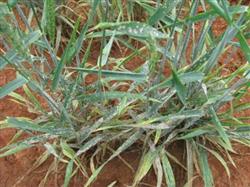
The disease can attack all aboveground organs of the wheat plant, but mainly the leaves and leaf sheaths; in severe cases, the glumes and awns can also be affected. At the initial stage of the disease, white mildew spots of 1-2mm appear on the leaf surface, which then gradually expand into nearly circular to oval white mildew patches. The surface of the mildew patches has a layer of white powder that disperses immediately upon external force or vibration. These powdery substances are the mycelium and conidia of the fungus. In the later stage, the mildew layer on the diseased part turns grayish-white to light brown, and small black grain-like dots the size of pinheads, namely the cleistothecia of the pathogen, are scattered on the lesions.
Morphological characteristics:
The mycelium is ectophytic, spreading over the host surface and forming haustoria within the host epidermal cells to absorb host nutrients. At the tips of conidiophores perpendicular to the mycelium, 10-20 conidia are borne in chains. They are oval, unicellular, colorless, measuring 25-30 x 8-10 (um), with infectivity lasting 3-4 days. The small black dots produced on the diseased parts, namely the cleistothecia of the pathogen, are black and spherical, measuring 163-219um, with 18-52 poorly developed filamentous appendages on the outside, containing 9-30 asci. The asci are oblong or oval, containing 8 ascospores, sometimes 4. The ascospores are round to oval, unicellular, colorless, uninucleate, measuring 18.8-23 x 11.3-13.8 (um). The perithecia generally form in the late growth stage of wheat, and after maturing, they split open under suitable temperature and humidity conditions, releasing ascospores. This fungus cannot infect barley, and barley powdery mildew does not infect wheat either. Under long-term interaction with hosts in different geographical and ecological environments, wheat powdery mildew can form different physiological races, with very rapid virulence variation.
Occurrence conditions:
Wheat powdery mildew is a disease caused by fungi, usually overwintering as cleistothecia, or as mycelium on winter wheat seedlings. In recent years, due to the influence of varieties, cultivation systems, fertilizer and water management, and climatic conditions, powdery mildew has occurred extensively, causing early withering of wheat leaves, reduced spike formation rate, and decreased thousand-grain weight, seriously affecting the quality and yield of wheat. Wheat powdery mildew is relatively sensitive to temperature and humidity. In the Huang-Huai wheat region, the temperature before winter is relatively low, and the disease is unlikely to occur. In early spring of the following year, when the temperature rises to 12 degrees, the diseased seedlings produce conidia and carry out primary infection. When the ambient temperature is suitable and the humidity is above 70%, the disease is very likely to become epidemic.
Harmful symptoms:
Wheat powdery mildew mainly harms the leaves. It initially forms scattered white filamentous mildew patches on the leaf surface, which gradually expand and merge into oval mildew patches. In severe cases, it can cover most or all of the leaf surface. The mildew layer is about 1 millimeter thick, initially powdery white, then turning gray, and then brownish-gray. The affected leaf surface turns yellow and withered early, and the diseased plants are stunted; in severe cases, they cannot form spikes. The disease can attack all aboveground organs of the wheat plant, but mainly the leaves and leaf sheaths; in severe cases, the glumes and awns can also be affected. At the initial stage of the disease, white mildew spots of 1-2mm appear on the leaf surface, which then gradually expand into nearly circular to oval white mildew patches. The surface of the mildew patches has a layer of white powder that disperses immediately upon external force or vibration. These powdery substances are the mycelium and conidia of the fungus. In the later stage, the mildew layer on the diseased part turns grayish-white to light brown, and small black grain-like dots the size of pinheads, namely the cleistothecia of the pathogen, are scattered on the lesions.
Control measures:
Select disease-resistant varieties, sow at the appropriate time, plant at a reasonable density, and fertilize according to a balanced formula to prevent excessive nitrogen application from causing excessive vegetative growth, poor light penetration and ventilation of the population, and reduced disease resistance.
Carry out timely drainage and irrigation to avoid both waterlogging and drought, so that the plants grow robustly. Treat seeds with 15% triadimefon wettable powder at 0.03% of the dry seed weight. From the booting stage to the heading stage, spray with 70% thiophanate-methyl at 1000 times dilution or 16% triadimefon wettable powder and other pesticides at 1000 times per mu, generally spraying 2 times with a 10-day interval, achieving a control effect of about 90%.