What are the main cultivation techniques for asparagus? A detailed explanation
1. Cold-frame seedling raising The cold frame should be chosen in a spot sheltered from the wind and facing the sun, with convenient irrigation, and close to the asparagus field where it will be planted out. Generally the frame surface runs east-west, with a frame length of 10-13 m, width of 1-1.5 m, and depth of 20-25 cm. The surroundings are tamped solid, forming a frame wall 25 cm thick that is higher in the north and lower in the south. The north wall is 33 cm high, the south wall 12 cm high, and the frame walls on the east and west sides connect with the north and south frame walls. Choose agricultural film 1.5-2 m wide and straw mats 2 m wide and 6-7 m long as the cold-frame covering material. At the same time, prepare wooden poles to support the covering material. The poles are about 2 m long, with both ends placed on the north and south frame walls, one placed every 60 cm. Before sowing, apply to each frame 200 kg of sieved, fully decomposed high-quality farmyard manure, 5-10 loads of human excrement and urine, 5 kg of compound fertilizer, and 0.25 kg of carbofuran or 0.25 kg of phorate (to prevent underground pests). Sowing begins in late February: after sowing, regulate the temperature inside the frame by uncovering and covering the straw mats and agricultural film. The temperature is generally controlled at around 25°C. Seedlings begin to emerge about 20 days after sowing. When the seedlings are 15-20 cm tall, remove the straw mats and film to harden the seedlings. The seedling age is 45-50 days, and they can be planted out once there are more than 3 aboveground stems.
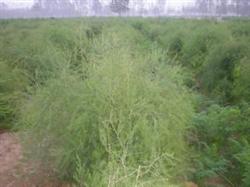
1. Cold-frame seedling raising
The cold frame should be chosen in a spot sheltered from the wind and facing the sun, with convenient irrigation, and close to the asparagus field where it will be planted out. Generally the frame surface runs east-west, with a frame length of 10-13 m, width of 1-1.5 m, and depth of 20-25 cm. The surroundings are tamped solid, forming a frame wall 25 cm thick that is higher in the north and lower in the south. The north wall is 33 cm high, the south wall 12 cm high, and the frame walls on the east and west sides connect with the north and south frame walls. Choose agricultural film 1.5-2 m wide and straw mats 2 m wide and 6-7 m long as the cold-frame covering material. At the same time, prepare wooden poles to support the covering material. The poles are about 2 m long, with both ends placed on the north and south frame walls, one placed every 60 cm. Before sowing, apply to each frame 200 kg of sieved, fully decomposed high-quality farmyard manure, 5-10 loads of human excrement and urine, 5 kg of compound fertilizer, and 0.25 kg of carbofuran or 0.25 kg of phorate (to prevent underground pests). Sowing begins in late February: after sowing, regulate the temperature inside the frame by uncovering and covering the straw mats and agricultural film. The temperature is generally controlled at around 25°C. Seedlings begin to emerge about 20 days after sowing. When the seedlings are 15-20 cm tall, remove the straw mats and film to harden the seedlings. The seedling age is 45-50 days, and they can be planted out once there are more than 3 aboveground stems.
2. Planting method
On the prepared plot, mark points and draw lines at a width of 180-200 cm to determine the planting row positions; a north-south row direction is best. Along the planting rows, dig planting trenches 50-60 cm wide and 40-50 cm deep, placing the topsoil and subsoil separately on either side of the row. Then, first backfill the trench with 25 cm of topsoil, apply 2500-3000 kg of decomposed farmyard manure and 40 kg of nitrogen-phosphorus-potassium compound fertilizer per mu, mix the soil and fertilizer evenly, then fill in the subsoil level with the ground and water to settle it. When planting, first open a small furrow 15 cm deep on the trench, place the asparagus seedlings in the furrow at a certain plant spacing, straighten the seedlings, and spread the root system out. The side of the underground stem where the scale bud cluster grows should be parallel to the row direction, then cover with 7-10 cm of soil, firm it, and water. Generally, when the row spacing is 180 cm, the plant spacing is about 30 cm; when the row spacing is 200 cm, the plant spacing is about 25 cm, planting 1200-1400 plants per mu.
3. Fertilizer and water management
According to the characteristics of asparagus's annual growth and development stages, fertilizer is mainly applied three times a year. That is, before harvesting spears, apply a sprouting fertilizer together with ridging: with an N:P:K fertilizer ratio of 5:3:5, apply 10 kg of urea, 15-30 kg of superphosphate, and 9 kg of potassium chloride per mu, or 30 kg of special compound fertilizer, and at the same time 50 kg of decomposed cake fertilizer may be mixed in. After harvesting ends, remove the ridges and apply a rejuvenation fertilizer: with an N:P:K fertilizer ratio of 5:4:4, apply 5000 kg of decomposed farmyard manure, 25-30 kg of urea, 80 kg of superphosphate, and 15-20 kg of potassium chloride per mu, or use 50 kg of compound fertilizer, and at the same time apply 100 kg of decomposed cake fertilizer. Around the Beginning of Autumn, apply an autumn growth fertilizer: apply 10-15 kg of urea, 30-45 kg of superphosphate, and 8-10 kg of potassium chloride per mu, or 30-50 kg of special compound fertilizer. Each fertilization should be carried out together with watering.
4. Harvesting
The key to white asparagus production is to ridge up the soil to blanch the spears before harvest. Generally, when the 10 cm soil temperature reaches 10°C, ridging can begin. In Yongji City, Shanxi, ridging is generally done around March 20, and harvesting can begin 10-15 days after ridging. The height and width of the ridge depend on the raw material purchasing standards of asparagus processing plants and the size of the root crown. Generally the ridge is 60 cm wide at the bottom, 40 cm wide at the top, and 25 cm high. Because asparagus young spears easily change color and age when exposed to light, reducing quality, the harvesting time should be chosen in the early morning and evening. After harvesting, grade and sell immediately.
5. Integrated control of major pests and diseases
The main pests and diseases of asparagus are stem blight, brown spot disease, the fourteen-spotted leaf beetle, cutworms, and so on. Adopt a method that gives priority to prevention and combines agricultural control with chemical control. In February, clear the dead branches and fallen leaves in the field, and spray carbendazim on the ground for disinfection to reduce sources of infection. After harvesting ends, alternately spray pesticides such as Asparagus Qing No. 2, Baike De, and Decis, once every 7-10 days, which can effectively prevent pest and disease damage.