Detailed Explanation of Asparagus Intercropping and Relay Cropping Vegetable Cultivation Techniques
Asparagus brown spot disease is an important disease affecting asparagus quality and yield, and it occurs commonly in various regions. 1. Pathogen: Asparagus brown spot disease is caused by infection by fungi of the genus Cercospora in the Deuteromycotina. 2. Symptom identification: When plants are affected, stems, lateral branches, and cladodes all suffer damage; diseased leaves turn yellow, dry up, and fall...
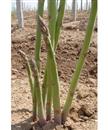 Cultivating asparagus requires relatively wide row spacing. In newly planted open-field asparagus, some short-statured vegetables can be intercropped between the rows to achieve multiple harvests in one year and realize the goal of high yield and high efficiency. In Shiliu Town, Donghai County, Jiangsu, this model has been used for cultivation since 1995, with an output value of more than 10,000 yuan per mu.
I. Asparagus Cultivation Management
1. Variety selection. High-quality, high-yield asparagus varieties include Mary Washington 500, Mary Washington 500W, California 72, California 873, Lu Asparagus No. 1, Asparagus King, and others. They can be selected according to local conditions.
2. Sowing and seedling raising. Sowing can be done when the soil temperature at 5 cm below ground reaches above 10°C, and sowing from May to June is preferable. Prepare the seedbed at a ratio of 1:10-12 between the seedbed and the field. Before sowing, clear water can be used to remove seeds floating on the water surface, then soak the seeds in a 1000-fold dilution of Usprulon for 12-24 hours. The sowing bed is 1.2 m-1.5 m wide. Open transverse furrows every 40 cm, with a furrow depth of 2 cm. Sow 1 seed every 7-10 cm in the furrows, cover with 2 cm of fine soil, and cover with 3-5 cm of wheat straw. For each mu of field planted, use 400-500 g of seed. When 60% of the seeds have emerged, remove the wheat straw. When the seedlings are 10-15 cm tall, apply 41 kg of urea and 3 kg of potassium chloride per mu, broadcast them, and then water. After that, topdress once each month, with the final topdressing in mid-September.
3. Land preparation and planting. Apply 4000 kg of decomposed organic fertilizer per mu, plow deeply 25-30 cm, and rake the ground level. For harvesting white asparagus, open 1 furrow every 1.8 m-2 m; for harvesting green asparagus, open 1 furrow every 1.5 m. The furrows are 30-40 cm deep and 50-60 cm wide. Apply 2000 kg-3000 kg of decomposed barnyard manure, 30 kg-50 kg of superphosphate, 10 kg of potassium chloride, and 15 kg of ammonium sulfate in the furrows per mu, mix thoroughly with the soil, and tread firm. Then spread a 1-layer of 8 cm thick soil before planting seedlings. Planting is carried out in October-November or from late February to early March. When planting, cut the aboveground stems short, leaving 20 cm. Plant spacing is 40 cm, and cover with 5-6 cm of soil. Later, combine topdressing with shallow hoeing so that the root crown is buried 10 cm deep underground.
4. Field management. Cultivating asparagus requires more organic fertilizer. After harvest each year, apply 1500 kg-2000 kg of barnyard manure, 5 kg-8 kg of urea, 30 kg-40 kg of superphosphate, and 15 kg of potassium chloride deeply per mu. Bury the applied fertilizer into the soil. In early to mid-August, apply another topdressing per mu of 1000 kg of human manure and urine (or 10 kg of urea), 30 kg of superphosphate, and 15 kg of potassium chloride. During the harvest period, the soil should maintain a certain amount of moisture. Drain water promptly during the rainy season. After watering or rainfall, hoe shallowly in time. For harvesting white asparagus, earth up in spring before young stems emerge. In early to mid-March, earth up when the soil temperature at 10 cm below ground reaches above 10°C. The depth of earthing up is 15 cm. Harvesting begins 10-15 days after earthing up. After harvest ends, immediately uncover the earth and expose the rhizomes to the sun for 2-3 days, then combine with the first topdressing to restore the ground surface to the state before earthing up. To prevent waterlogging and improve aeration, the soil around the plants can be slightly higher than the soil surface between rows.
5. Pest and disease control. The main diseases of asparagus include stem blight, brown spot disease, root rot, and damping-off. In winter, when the aboveground stems wither, they should be pulled out, and fallen leaves and dead branches should be swept up and burned away from the plot. Timely intertillage and weeding should be carried out. Drain water promptly during the rainy season so that the soil is always in an alternating dry-wet state. When young stems emerge to 10 cm high, spray 0.5%-0.7% Bordeaux mixture, or 50% carbendazim wettable powder 800-1000-fold dilution, or 75% chlorothalonil wettable powder 800-1000-fold dilution. After that, spray once every 10 days. Prevention should be primary. Once disease occurs, spray 64% oxadixyl-mancozeb 1000-fold dilution for control. "
The main underground pests of asparagus are cutworms, wireworms, and white grubs. Pests damaging its aboveground parts include cotton leafworm and thrips. For underground pests, poisoned bait can be used to trap and kill them; for aboveground pests, pyrethroid pesticides can be sprayed for control.
II. Management of Intercropped and Relay Cropped Vegetables
1. Overwintering spinach. Sow from mid-September to late November. Sow 4 rows between asparagus rows, with plant and row spacing of 10 cm x 15 cm. Harvest in mid-to-late March.
2. Spring-summer cauliflower. In mid-March, raise seedlings in small arched sheds. In late April, after asparagus harvest, transplant them between asparagus rows, 2 rows, with row and plant spacing of 40 cm x 40 cm, and harvest from late June to early July. If harvesting green asparagus, the sowing and transplanting time of green cauliflower can be advanced by 20-25 days. Green cauliflower can also be replaced with short-statured kidney beans, or spring-summer Chinese cabbage, head lettuce, short-statured tomatoes, and fennel and other short-statured vegetables. For the next crop, short-statured autumn vegetables can be cultivated, such as purple cabbage, black five-field carrots, radishes for fresh eating, and tongtong and other vegetables. Especially for the cultivation of leafy vegetables, timely adjustments can be made according to the market to obtain higher economic benefits.