Detailed Guide to Symptom Identification and Control Methods for Asparagus Stem Blight
Asparagus is a valuable vegetable with excellent taste and quality. With the continuous improvement of people's living standards, the demand for asparagus in domestic and international markets is growing. Because asparagus has strong drought tolerance, it is particularly suitable for cultivation in the Tianjin area. However, as the number of planting years increases and the area expands, the occurrence of stem blight becomes more and more severe, with some fields...
Asparagus is a valuable vegetable with excellent taste and quality. With the continuous improvement of people's living standards, the demand for asparagus in domestic and international markets is growing. Because asparagus has strong drought tolerance, it is particularly suitable for cultivation in the Tianjin area. However, as the number of planting years increases and the area expands, the occurrence of stem blight becomes more and more severe. In some fields, the disease incidence reaches about 80%, and some are even completely destroyed, seriously affecting the healthy development of the asparagus industry. Therefore, it is particularly important to detect disease symptoms early and take timely comprehensive control measures, with prevention as the priority and treating both root causes and symptoms.
I. Disease Symptoms
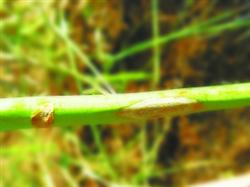
The lesions mainly occur on stems and branches, first appearing on the lower part of young stems near the ground. Initially, they are small milky-white spots, which gradually expand into small spindle-shaped or fusiform water-soaked spots and gradually turn brown, with the center appearing grayish-brown, sunken, and scattered with small black dots (i.e., pycnidia). When the disease is severe, the lesions cover the entire plant. When a lesion encircles the stem completely, the entire plant dries up and dies.
II. Control Methods
1. Select disease-resistant varieties and properly treat seeds
Currently, the introduced Mary Washington 500 is relatively resistant to stem blight. For selected seeds, hot water soaking or chemical treatment should be carried out before sowing. Seeds can be soaked in warm water at 50°C for 10 min, taking care to pour the water first and then add the seeds while stirring constantly so that the seeds are heated evenly. Seeds can also be treated with chemicals such as thiram, which has a good sterilizing effect and can reduce disease occurrence.
2. Reasonably select plots
Asparagus fields arranged in heavy clay soil, low-lying areas, near orchards, or paddy fields are prone to disease; while plots with high terrain, loam or sandy loam soil have good drainage and aeration, a clean environment, and fewer disease occurrences.
3. Reasonable close planting
In the Tianjin area, wide-row close planting (row spacing 180 cm × plant spacing 50 cm) is more suitable. Excessive density or inappropriate intercropping within 1-2 years after transplanting will cause mutual shading and form a hot and humid microclimate, which is conducive to disease occurrence. It is particularly emphasized that intercropping any crop in asparagus harvesting fields is strictly prohibited.
4. Timely and reasonable fertilization and drainage
Asparagus has a large growth volume and a high fertilizer requirement, so fertilizer should be applied in a timely manner, especially sufficient basal fertilizer. Apply 5000 kg of organic fertilizer per 667 sq m, and apply chemical fertilizer as a top dressing according to seedling condition. Asparagus is a crop that likes phosphorus and potassium, so care should be taken not to apply excessive nitrogen fertilizer, to ensure the nutritional needs of asparagus, promote robust growth, and improve its own disease resistance. During the rainy season, timely drainage is needed to reduce the humidity of the asparagus field and reduce the spread of pathogens.
5. Timely cultivation and weeding
The occurrence of weeds not only affects plant growth but also intensifies the spread of disease. Timely cultivation and weeding should be carried out to remove dead stems and leaves, which is conducive to ventilation and light penetration and reduces disease occurrence.
6. Do a good job in overwintering control
In winter or spring, field cleaning should be done well. All remaining stems and leaves above ground should be cleared out of the asparagus field and burned to reduce sources of inoculum. Around April, spray the soil or crown with 50% carbendazim 1000-1500 times dilution or 70% thiophanate-methyl 1000-1500 times dilution, which can greatly reduce the primary infection source and control the disease as early as possible.
7. During the peak incidence period, persist in chemical control
In the Tianjin area, July-August is the rainy season with high temperature and high humidity, which is the peak period for asparagus stem blight. Chemical spray must be applied once every week. Commonly used chemicals are: 75% chlorothalonil 600 times dilution; 80% zineb 600-800 times dilution; 70% thiophanate-methyl 1000 times dilution. Because stem maturity affects susceptibility, the disease first appears on young stems, so when spraying, the target should be precise, with young stems that have just emerged as the main target, to achieve better control results.