Detailed Explanation of Key Points for Summer Asparagus Cultivation Techniques
I. Asparagus stem rot (dieback) 1. Symptoms. This disease, also known as wilt disease, is a soil-borne disease. At first, individual plants in the field turn yellow and wilt; as the disease spreads, the entire plant dies. When young spears are infected, the cladodes and stems turn brown or split longitudinally. On diseased plants, brown lesions can appear on the underground stems and roots, and in the later stages the diseased parts rot, producing white to pink mold...
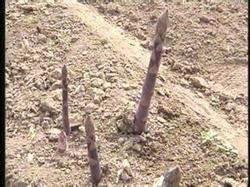 I. Raising seedlings The F1 generation white asparagus "Lulu No. 1" and the green asparagus "Lüfeng" bred by the China Asparagus Research Center are suitable for planting in our province.
II. Selection of seedling-raising site
Raising seedlings for one mu of asparagus generally requires 25-30 sq m of seedling land. After the wheat harvest, a plot at the edge of the field that is relatively flat, easy to irrigate and drain, and free of perennial weeds can be chosen for raising seedlings. When raising seedlings, apply sufficient base fertilizer on the seedling land, plow deeply once, then make furrows 10 cm apart. Along the furrows, sow one seed every 10 cm at a depth of 2-3 cm. After sowing, rake the soil surface level. If heavy rain occurs, a small amount of wheat straw can be scattered on the surface of the seedbed to prevent erosion by torrential rain and damage from high temperatures.
III. Seedling-stage management
When the first stem of the asparagus grows cladodes, top-dress once. Use mainly quick-acting fertilizer, applying about 25 kg per mu of diammonium phosphate or compound fertilizer, and irrigate thoroughly once at the appropriate time. Afterward, hoe weeds, water, and drain waterlogging promptly according to conditions.
When the asparagus seedlings grow to about 10 cm, rake away the wheat straw. When the seedling age reaches more than 60 days, the aboveground stems reach more than 3, and the height is more than 30 cm, and the cladodes turn dark green, they can be transplanted to the field.
IV. Transplanting
Asparagus seedlings raised this spring are now in the transplanting season. After the wheat harvest, apply 250-500 kg of organic fertilizer per mu, plow deeply once, and open furrows to transplant the asparagus seedlings. Generally, a depth at which the asparagus crown is 10 cm from the soil surface is suitable.
Green asparagus is generally transplanted at 2500-2800 plants per mu, while white asparagus is suitably transplanted at 1800-2000 plants per mu. Generally, transplant in a north-south direction, and water promptly after transplanting.
Asparagus seedlings raised from June to August can be transplanted after the autumn corn harvest, or in the following spring.
V. Reasonable intercropping
Asparagus is a perennial herbaceous plant with fleshy roots, and one planting can be harvested continuously for 10-15 years. In the year of transplanting, the row spacing is relatively wide, so some short-statured vegetables can be intercropped according to the season, such as cabbage, Chinese cabbage, carrot, rapeseed, spinach, etc.; some short-stalked legume crops can also be planted, such as mung bean, adzuki bean, etc.