Detailed explanation of key asparagus seedling-raising techniques, full guidance from sowing to emergence
The key cultivation techniques for asparagus are introduced as follows: 1. Variety selection. Unlike other vegetables, asparagus is a perennial plant, and one planting can be harvested continuously for 15 years. Therefore, choose first-generation hybrid varieties with resistance to pests and diseases, strong stress resistance, a short dormancy period, good market quality, and high quality and yield. 2. Seedling raising...
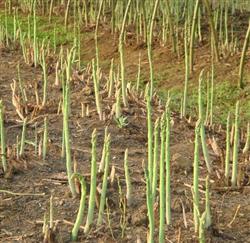
The key cultivation techniques for asparagus are introduced as follows:
I. Variety selection
Unlike other vegetables, asparagus is a perennial plant, and one planting can be harvested continuously for 15 years. Therefore, choose first-generation hybrid varieties with resistance to pests and diseases, strong stress resistance, a short dormancy period, good market quality, and high quality and yield.
II. Seedling raising
1. Sowing. Use 90-360 seeds per sq m. The suitable germination temperature for asparagus seeds is 25°C-30°C. Sowing times are January-February for greenhouse seedling raising; February-March for cold-frame seedling raising; late March to late April for low-tunnel seedling raising; late April to mid-August for open-field seedling raising.
2. Seed treatment. Soak the seeds for 12 hours in a 300-fold dilution of 50% carbendazim (or 75% chlorothalonil wettable powder); then rinse with clean water, and soak the seeds in warm water at 25°C-30°C for 24 hours, changing the water 1-2 times a day. When changing the water, rub and wash the seeds repeatedly to remove the mucus, shriveled seeds, and impurities on the seeds.
3. Germination promotion. Wrap the soaked seeds in a wet cloth and place them under conditions of 25°C-28°C to promote germination. Rinse with clean water 1-2 times a day. When 5%-10% of the seeds have sprouted white, they can be sown.
4. Seedbed preparation. Land preparation and fertilization: apply 3-5 kg of high-quality decomposed organic fertilizer and 20 kg of ternary compound fertilizer per sq m, and plow deeply into the soil.
Making beds and sowing: the bed width is 1.4 m, the length is unlimited, and the bed ridge width is 0.2 m. In the greenhouse, sow single seeds at a spacing of 5 cm x 5 cm; in the open field, open sowing furrows at 10 cm x 10 cm, with a furrow depth of 2-3 cm. After sowing, cover the furrows level and water thoroughly immediately. For greenhouse cold-frame and low-tunnel seedling raising, cover with film before sowing. For seedling raising in nutrient pots (blocks), sow one seed per pot (block), then cover with 1.5-2 cm of nutrient soil.
5. Seedbed management. (1) Temperature: the suitable soil temperature is 15°C-25°C; the air temperature from sowing to emergence is 25°C-30°C; the air temperature from emergence to before transplanting is 20°C-25°C. When it is lower than 15°C, try to increase the temperature; when it is higher than 35°C, ventilate and cool down.
(2) Fertilizer and water: keep the bed soil moist before emergence, and alternate between dry and wet after emergence. Every 15 days, spray 7 g of potassium dihydrogen phosphate and urea (1:1) per sq m at a concentration of 0.5%.
III. Transplanting
1. Transplanting period. In our province, transplanting is in late April to mid-May in spring and late July to early August in autumn.
2. Transplanting density. Transplant in furrows, with a row spacing of 1.2-1.5 m and a plant spacing of 25-30 cm, and a density of 1500-2200 plants/mu.
3. Transplanting method. Transplant the seedlings in the middle of the furrow at a plant spacing of 25-30 cm, with the rhizome disc 10 cm from the ground. Keep the underground stem in the same direction as the furrow. Lift the seedlings and plant them the same day, and water immediately after transplanting.
4. Management after transplanting. After transplanting, check the seedlings and fill in gaps promptly. One month after transplanting, combine with watering and apply 5 kg/mu of urea as a seedling-promoting fertilizer. Apply compound fertilizer once every month, increasing by 1 kg/mu each time thereafter.
Throughout the entire growing season of asparagus, pay attention to intertillage and weed control, and combine intertillage with hilling several times. The hilling height is 10 cm, forming a turtle-back-shaped high ridge, and drain promptly in case of waterlogging.