Detailed Explanation of High-Efficiency Cultivation Techniques for Fresh-Eating Corn in Greenhouses
In winter-warm greenhouses, during the late stage of spring production, the vegetable plants inside the greenhouse age, yield and quality decline, market prices are low, and planting benefits decrease. At this time, transplanting fresh-eating corn in the winter-warm greenhouse can rationally utilize greenhouse resources and achieve relatively high economic benefits. 1. Select excellent varieties: according to local conditions, select high-quality fresh...
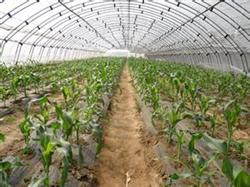
In winter-warm greenhouses, during the late stage of spring production, the vegetable plants inside the greenhouse age, yield and quality decline, market prices are low, and planting benefits decrease. At this time, transplanting fresh-eating corn in the winter-warm greenhouse can rationally utilize greenhouse resources and achieve relatively high economic benefits.
1. Select excellent varieties: according to local conditions, select high-quality fresh-eating corn varieties, such as Zhongnuo No. 1, Suyunuo No. 1, Yuanzhe No. 1, etc.
2. Raising seedlings: sow in late February, raise seedlings in pots, first sprout on a sand base, and sow after the seeds germinate, one seed per pot, covering with 3 cm of soil after sowing. After sowing, place the pots in empty spaces in the greenhouse, and the greenhouse can continue producing vegetables. Keep the greenhouse temperature no higher than 30°C during the day and no lower than 6°C at night, and ventilate to harden the seedlings before transplanting.
3. Land preparation and ridging: in mid-April, when the corn has grown to 6 to 7 leaves, pull out the vegetables in the greenhouse. After turning the soil, form ridges with a ridge spacing of 0.5 m. At the same time, apply 45,000 kg of farmyard manure per hectare and 225 kg of compound fertilizer, and after leveling the land, cover it with plastic film and press it firmly.
4. Transplanting: dig holes at a plant spacing of 30 cm and plant the seedlings, water first and then cover with soil. When transplanting, select the seedlings, choosing seedlings that are basically uniform in size, robust in growth, and well developed in root system for transplanting. Water once the second day after transplanting to prevent the young seedlings from dehydrating.
5. Rational close planting: in order for each corn plant to grow a good commercial ear, planting should not be too dense, and 54,000 plants per hectare is suitable.
6. Management: prevent high-temperature damage to seedlings in the greenhouse. When the temperature inside the greenhouse reaches above 35°C, ventilate to cool it down, and by the middle stage of growth the greenhouse can be removed.
7. Harvesting: fresh-eating corn can be harvested and marketed 20 to 25 days after the female ear silks, when the fresh ear is at the milk-ripe stage and the taste is moderate. It can generally be marketed in mid-June, about one month earlier than open-field cultivation, and has relatively high commercial value.