Integrated control methods for three pests of spring soybean
I. Cutworms. The main pest damaging local crops is the yellow cutworm (Agrotis segetum). 1. Damage characteristics: The larvae mostly bite off seedlings at ground level, causing missing plants and broken rows. After the main stem becomes lignified, they feed on the epidermis of the roots near the ground surface, causing root damage that affects the root's ability to absorb water, causing the plant to gradually wilt and die. ...
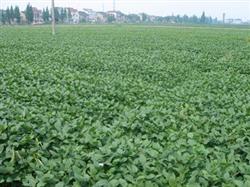
I. Cutworms. The main pest damaging local crops is the yellow cutworm (Agrotis segetum).
1. Damage characteristics: The larvae mostly bite off seedlings at ground level, causing missing plants and broken rows. After the main stem becomes lignified, they feed on the epidermis of the roots near the ground surface, causing root damage that affects the root's ability to absorb water, causing the plant to gradually wilt and die.
2. Life habits: 2 generations occur per year. Generally, 4th-6th instar larvae overwinter in the soil layer at a depth of 2-15 cm, most commonly at 7-10 cm. They mainly concentrate for overwintering in the sunny side of field ridges and ditch embankments at 5-8 cm in the soil. In early March of the following spring, the overwintering larvae begin activity. In early to mid-April, they build chambers in the soil and pupate; the pupal stage lasts 20-30 days. Damage is most severe in May-June. Adults hide by day and emerge at night, with strong phototaxis and chemotaxis. Eggs are mostly laid singly on the soil surface on dead branches, fallen leaves, root stubble, and on leaves of plants 1-3 cm above the ground. Generally, lamb's quarters (Chenopodium album), creeping thistle (Cirsium arvense), and field bindweed (Convolvulus arvensis) are the indicator plants on which the yellow cutworm feeds and lays eggs. Damage is most severe after the larvae reach the 3rd instar. Damage occurs in both spring and autumn each year, but spring damage is more severe than autumn damage.
3. Control measures (1) Forecasting: For adult monitoring, blacklight lamps or sugar-vinegar liquid can be used to trap moths, generally from mid-April to mid-May. The day with the highest moth catch is the peak period; counting forward 20-25 days from that is the peak period of 2nd-3rd instar larvae, which is the suitable control period. For larval monitoring, field survey methods are used. If there are 0.5-1 larvae per square meter before thinning, or 0.1-0.3 larvae per square meter after thinning, control should be carried out. Dry climate favors major outbreaks. (2) Agricultural control: ① Choose good crop rotation; the previous crop should preferably not be corn, and rotation should be with wheat and rice. ② Carry out timely autumn plowing and winter irrigation to eliminate pest sources, and clear weeds from field edges and corners in early spring. (3) Trapping control: ① Blacklight lamps to trap and kill adults. ② Sugar-vinegar liquid to trap and kill adults. (4) Chemical control: ① Spraying: Cutworm larvae at the 1st-3rd instar stage have poor pesticide resistance and are exposed on host plants or on the ground, making this the suitable period for chemical control. Use 90% trichlorfon crystal at 800-1000 times dilution, 50% phoxim emulsifiable concentrate at 800 times dilution, 50% fenitrothion at 1000-2000 times dilution, 20% fenvalerate-malathion emulsifiable concentrate at 1000-1500 times dilution, or 2.5% deltamethrin (Decis) emulsifiable concentrate at 3000 times dilution for spraying. ② Poison bait: Mostly used when larvae begin feeding after the 3rd instar. Use 0.5 kg of 2.5% trichlorfon powder per mu, or 90% trichlorfon crystal at 1000 times dilution evenly mixed with chopped fresh grass, or use 90% trichlorfon crystal dissolved in 2.5-5 kg of water, evenly mixed with 50 kg of roasted wheat bran or crushed cottonseed cake (oil residue); use 50 g of 50% phoxim emulsifiable concentrate mixed with 5 kg of cottonseed cake. The prepared poison bait is scattered in small piles at regular intervals in vegetable fields in the evening.
II. Alfalfa looper (Autographa californica). A new pest that began breaking out in our region in 2004, often mistaken by local people for cabbage worm or cotton bollworm.
1. Damage characteristics: The larvae are voracious feeders, consuming leaves and causing large areas of leaf notching. They also feed on flower buds and bean pods.
2. Life habits: In northern China, 2 generations occur per year, overwintering as pupae in the soil. Each year in June, the first-generation adults emerge and lay eggs; the egg stage lasts about 7 days. From mid-June to mid-July, they damage soybean and other crops. Young larvae have the habit of spinning silk and rolling leaves, feeding inside; after growing larger, they no longer roll leaves and consume large amounts of leaves. The first-generation larvae enter the soil in July to build earthen cocoons and pupate. Adults emerge and lay eggs in August. The second-generation larvae, in addition to feeding on leaves, also heavily bore into bean pods and other fruits, causing severe damage. In September, the larvae mature, enter the soil, build earthen cocoons, and pupate for overwintering. Adults need to feed on nectar to supplement nutrition and have phototaxis. Young larvae have the habit of escaping backward when startled; older larvae bounce to the ground when disturbed.
3. Control methods: (1) Use blacklight lamps and sugar-vinegar basins to trap and kill adults. (2) Chemical control: Before the larvae reach the 3rd instar, use 21% methomyl emulsifiable concentrate at 6000 times dilution, 2.5% cyhalothrin emulsifiable concentrate at 5000 times dilution, 2.5% bifenthrin emulsifiable concentrate at 3000 times dilution, and other broad-spectrum insecticides for spray control.
III. Red spider mite
1. Damage characteristics: Adults, nymphs, and protonymphs spin webs on the underside of leaves and suck sap. Affected soybean leaves initially show yellow-white spots, which gradually become gray-white patches and red patches. In severe cases, leaves curl, scorch, and fall off; severely affected fields look as if burned by fire. Affected soybean plants grow stunted, with small pods and smaller seeds.
2. Life habits: Generally, female adult mites cluster on dead leaves in soybean fields, at weed roots, or in soil crevices to overwinter. More than 10 generations occur per year. When spring temperatures rise to an average of 5-7°C, overwintering females emerge and become active, first reproducing on weeds such as small thistle (Cirsium spp.), dandelion (Taraxacum spp.), and plantain (Plantago spp.). In June-July, they move to soybean, spinning silk and forming webs on the underside of leaves where they cluster and cause damage. The peak damage period is in late July, gradually decreasing in early August. If continuous high temperature and drought occur in June-July, reproduction is fast and damage is severe. The optimum temperature is 29-30°C, and the optimum relative humidity is 35-55%. Abundant rain or increased humidity in soybean fields is unfavorable for the development of red spider mite eggs and adults/nymphs, and can reduce their numbers. Fields with extensive cultivation, many weeds, or sparse plant growth have more occurrences, often starting from field edges in patches and then spreading to the entire field.
3. Control methods (1) Agricultural control: Clear weeds and dead branches and fallen leaves from field edges, roadsides, and fields; plow and level the land to eliminate overwintering pest sources. Reasonable irrigation and fertilization to promote healthy plant growth and enhance resistance to mite damage. (2) Biological control: Important natural enemies of soybean red spider mite include various green lacewings, six-spotted thrips (Scolothrips takahashii), banded thrips, and some ladybugs, long bugs, and spiders, etc., which prey on red spider mites in the field and have a certain inhibitory effect on their occurrence. (3) Chemical control: Strengthen pest monitoring and control during the patchy occurrence stage. When scattered soybean plants are found with yellow-white spots on leaves indicating damage, immediately spray pesticides on those patches. Choose 20% pyridaphenthion emulsifiable concentrate, 20% dicofol emulsifiable concentrate, 30% fenbutatin oxide emulsifiable concentrate, or 40% isocarbophos, diluted to 1000 times, spraying 50 kg of diluted solution per mu; or 73% propargite emulsifiable concentrate at 1500 times dilution, using 50 kg of solution per mu. When spraying, point the nozzle upward and spray thoroughly from top to bottom, evenly. Given the characteristics of high soybean crop density and difficulty in spraying, "3911" at 0.15 kg mixed with 20 kg of sandy soil per mu can be broadcast in the field for fumigation control.