Occurrence and Control Methods of Soybean Rhizoctonia Damping-off
Soybean Rhizoctonia damping-off is commonly known as "dead seedling," "damping-off," or "black root disease." In years with severe disease, the rate of dead plants in lightly affected fields is 5%-10%, while in heavily affected fields the rate of dead plants reaches over 30%, and individual plots may even die off entirely, resulting in total crop loss. 1. Field symptoms: Soybean Rhizoctonia damping-off occurs only at the seedling stage, affecting the main root...
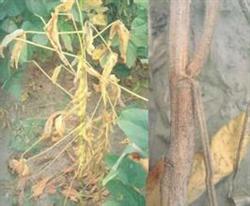
Soybean Rhizoctonia damping-off is commonly known as "dead seedling," "damping-off," or "black root disease." In years with severe disease, the rate of dead plants in lightly affected fields is 5%-10%, while in heavily affected fields the rate of dead plants reaches over 30%, and individual plots may even die off entirely, resulting in total crop loss.
1. Field symptoms: Soybean Rhizoctonia damping-off occurs only at the seedling stage. Reddish-brown, slightly sunken lesions appear on the main root and the base of the stem near the soil surface of seedlings and young plants, with the cortex cracking in an ulcer-like manner. The pathogen's mycelium is initially colorless and gradually turns brown. When the disease is severe, plants are stunted in appearance with delayed growth, the stem near the soil surface turns reddish-brown, and the cortex cracks in an ulcer-like manner.
2. Conditions for disease occurrence: Continuous cropping leads to severe disease, while crop rotation reduces its severity. This is because the pathogen accumulates in the soil year after year, increasing the inoculum load. Poor seed quality leads to severe disease. Any moldy or deteriorated seed will certainly result in severe disease, as the pathogen of damping-off can be transmitted by seed and is related to reduced seed germination vigor and decline in disease resistance. The earlier the sowing, the longer the field growth period of seedlings and the more severe the disease. Using diseased plant residues for composting without complete decomposition can spread the disease and cause severe occurrence. Fields with many underground pests, poor soil, fertilizer deficiency, and poor soybean growth have more severe disease.
3. Control methods: Select disease-resistant varieties. Treat seeds with chemicals. Mix seeds with 40% tolclofos-methyl emulsifiable concentrate or 50% thiram wettable powder at 0.3% of seed weight. Practice crop rotation, rotating with gramineous crops for 3 years. Choose well-drained, high, dry plots for planting soybeans. In low-lying areas, use ridge planting or high-bed deep-furrow planting, maintain reasonable planting density, prevent excessive surface moisture, and drain promptly after rain. Watering should be determined according to soil moisture and temperature.
4. At the early stage of disease, begin spraying the following chemicals: 40% fosetyl-aluminum wettable powder at 200 times dilution; 70% phosethyl-Al manganese zinc wettable powder at 500 times dilution; 58% metalaxyl-manganese zinc wettable powder at 500 times dilution; 69% dimethomorph-manganese zinc wettable powder at 1000 times dilution, once every 10 days or so, for 2-3 consecutive applications, ensuring even and thorough spraying.