Occurrence Patterns and Control Methods of Soybean Red Spider Mites
Red spider mites is the collective name for red leaf mites, a composite population of several leaf mite species belonging to the family Tetranychidae. In Huachuan County, they occur to varying degrees every year, though these are generally light occurrence years. However, according to this year's surveys, due to the effects of recent high temperatures and drought, the damage caused by red spider mites to soybeans in Huachuan County has risen from a secondary position to a primary...
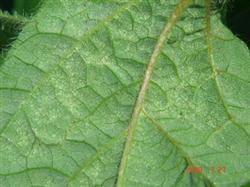
Red spider mites is the collective name for red leaf mites, a composite population of several leaf mite species belonging to the family Tetranychidae. In Huachuan County, they occur to varying degrees every year, though these are generally light occurrence years. However, according to this year's surveys, due to the effects of recent high temperatures and drought, the damage caused by red spider mites to soybeans in Huachuan County has risen from a secondary position to a primary position, and some townships have also suffered damage to varying degrees.
Damage characteristics: Adult mites and nymph mites gather on the underside of leaves, spinning silk to form webs, and suck plant juices. In the early stages of soybean leaf damage, yellow-white spots appear on the upper surface of the leaves. After 3 to 5 days, the spots expand in area and become denser, and reddish-brown patches begin to appear on the leaves. As the damage worsens, the leaves turn rusty brown, resembling scorching by fire, the leaves curl, and finally drop off.
Its morphological characteristics: The adult is a small red spider, with a body uniformly oval or pear-shaped. Body color varies greatly, generally orange-red or rusty red, with fine long bristles on the back. Body length and width are only a few millimeters. Egg: spherical, light yellow-white to orange-yellow. Larva: 3 pairs of legs, round body, yellow-white, after feeding becomes oval and light green, with dark green elongated patches appearing on both sides of the back. Nymph: 4 pairs of legs, light green to light orange-yellow, with bristles appearing on the back, and in later stages resembling the adult mite.
Its living habits: In Heilongjiang Province, it undergoes more than ten generations per year, overwintering as female adults at the roots of weeds and on soybean plant residues. It begins activity at the end of May the following year, first reproducing on weeds, then moving to soybeans to cause damage. Initially, it occurs in spots and patches, then spreads by crawling or dropping on silk threads carried by wind and rain. It first damages the lower leaves, then spreads upward. When the population becomes too large, they often gather at leaf tips, roll down, and disperse with the wind to spread to other plants. Fields with heavy nitrogen fertilizer application have more severe occurrence. When plants die and food becomes scarce, they have a migratory habit. July to August is the peak damage period. The older the plant leaves, the faster the leaf mites reproduce. Relative humidity of 35% to 55% is suitable for occurrence, while humidity above 70% is unfavorable. High temperature and drought weather is conducive to major outbreaks.
Chemical control techniques:
When red spider mites occur in spots and patches, choose pesticides with good efficacy, long residual activity, and no phytotoxicity.
1. 1.8% Abamectin EC 3000 times dilution.
2. 73% Miemanjing 3000 times dilution.
3. 20% Dicofol 1000 to 1500 times dilution.
4. 20% Manke EC 2000 times dilution.
In summary, choosing any one of the above pesticides can achieve control effectiveness. Biological agents such as avermectin or the bionic pesticide 1.8% Nongkeman EC at 2000 times dilution also work extremely well.