What are the pollution-free soybean diseases and their control methods?
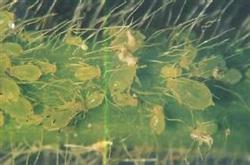
The soybean aphid is one of the major pests of soybean, with adults and nymphs piercing and sucking sap on the top leaves, tender leaves and tender stems of the soybean plant. In severe cases they cover the stems and leaves, and can also attack tender pods, causing stunted plants, reduced fruiting branches and pod numbers, and lower 1000-grain weight; when severe at the seedling stage, the entire plant can die, and in outbreak years if not controlled in time...
 (1) Root rot
Through seed treatment, use 2.5% Raxil suspension seed coating agent at 0.2%-0.4% of seed weight for seed coating control.
(2) Downy mildew
Spray with 58% mancozeb plus metalaxyl wettable powder at 500 times or 72% DuPont Curzate wettable powder at 800 times, or 65% mancozeb wettable powder at 500 times, for 1-2 sprays.
(3) Soybean frogeye leaf spot
At the early stage of disease, spray with 50% carbendazim wettable powder at 500-1000 times, with an interval of 7-10 days, for 2-3 consecutive sprays.
(4) Purple seed stain
After flowering, when disease occurs, spray with 50% carbendazim wettable powder at 1000 times or 70% thiophanate-methyl wettable powder at 1000 times for control.
(5) Anthracnose
In heavily diseased fields, spray with 50% carbendazim at 1000 times or 70% mancozeb wettable powder at 400-500 times for control.
(6) Mosaic disease
(1) Promptly remove diseased seedlings at the seedling stage.
(2) Control aphids
Spray with 10% imidacloprid wettable powder at 3000 times or 25% acetamiprid water-dispersible granules at 5000-10000 times for control.
(3) Chemical control
At the early stage of disease, spray with 1.5% Zhibingling emulsion at 1000 times or 20% virus A wettable powder at 500 times, once every 7-10 days, for 2-3 consecutive sprays.