What causes premature bolting in spring cabbage
Cabbage is a vegetable that loves fertilizer and tolerates it well. Generally, about 35 days after transplanting, the plant's uptake of nitrogen, phosphorus, calcium and other elements reaches its peak, while potassium uptake peaks at 50 days. Before reaching the peak values, the plant's fertilizer uptake basically shows a straight upward trend as the growth period progresses. Cabbage at different growth stages has different...
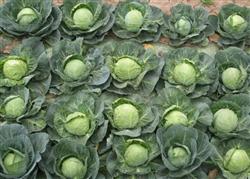 Spring cabbage is a plant that undergoes vernalization. When spring cabbage seedlings grow to about 12 leaves, with leaves 5-7 cm wide and a stem base thicker than 0.6 cm, exposure to low temperatures of 0-12°C for about 15-30 days, especially under low temperatures of 1-4°C, makes it more likely to pass through vernalization and produce "premature bolting." In the south, Jingfeng No. 1, and in the north, Zhonggan No. 11, are spring cabbage varieties with relatively strong winter hardiness and generally do not easily produce "premature bolting." They are deeply welcomed by vegetable growers, but when abnormal climate and improper cultivation management occur, "premature bolting" is still hard to avoid.
The reasons are as follows:
1. Relationship with climatic conditions
Abnormal climate during the seedling raising period and after transplanting of spring cabbage can also easily cause "premature bolting." For example, before mid-February 1993, the weather was warmer than the same period in previous years, so the seedlings grew faster and larger, while after mid-February the temperature dropped rapidly, and in some areas it rained and snowed several times, causing sustained low temperatures that gave the plants the conditions to pass through the vernalization stage. Therefore, spring cabbage in some areas produced "premature bolting."
2. Relationship with early or late sowing
The climate varies most from region to region, so the appropriate sowing time must follow the principle of adapting to local conditions. When climate changes are normal and sowing follows local practice, "premature bolting" generally does not easily occur, but under abnormal weather changes, the earlier the sowing, the more the overwintering seedlings tend to grow too large, the earlier the development period, the longer the time spent under low temperatures, and the greater the probability of "premature bolting." Conversely, with appropriate sowing, the smaller the overwintering seedlings, the shorter the time spent under low temperatures by the time they reach the developmental age, and even if low temperatures occur, mass "premature bolting" will not occur.
3. Relationship with early or late transplanting and management after transplanting
If spring cabbage is transplanted too early, especially when the weather is relatively warm, the seedlings grow faster and are more likely to produce "premature bolting" when they encounter low temperatures. In overwintering management, the more frequently and heavily topdressing is applied, the faster the seedlings grow and the longer they are exposed to low temperatures, so the "premature bolting" rate is also higher. If fertilizer application to the seedlings is appropriately controlled so that the seedlings grow slowly and overwinter before reaching the developmental age, "premature bolting" is not likely to occur.