What to Do When Mung Beans Get Root Rot? A Detailed Guide to Prevention and Control Methods
(1) Symptoms In the early stage of the disease, the young leaves turn yellow. If the root system is pulled out for observation, the lower part of the stem and the upper part of the main root can be seen to be dark brown and slightly sunken. When the stem is cut open, the vascular bundles have turned dark brown. When most of the roots have rotted, the plant withers and dies. (2) Disease conditions Low-lying terrain, high soil moisture, low soil temperature, and poor root development make the disease likely to occur. Stormy weather helps the pathogen spread and proliferate.
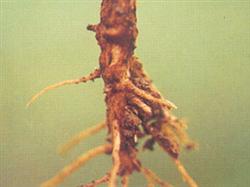
(1) Symptoms
In the early stage of the disease, the young leaves turn yellow. If the root system is pulled out for observation, the lower part of the stem and the upper part of the main root can be seen to be dark brown and slightly sunken. When the stem is cut open, the vascular bundles have turned dark brown. When most of the roots have rotted, the plant withers and dies.
(2) Disease conditions
Low-lying terrain, high soil moisture, low soil temperature, and poor root development make the disease likely to occur. Stormy weather helps the pathogen spread and proliferate.
(3) Prevention and control methods
1. Choose disease-resistant varieties and carry out crop rotation with non-legume crops for more than 3 years.
2. Cultivate the soil in time, drain water after rain, and raise the soil temperature.
3. In the early stage of the disease, choose 75% chlorothalonil 600-fold solution, or 15% Fulingling 600-fold solution, or 70% thiophanate-methyl 1000-fold solution for spraying, once every 7-10 days, for 2-3 consecutive sprays. If the above agents are used for irrigation, the effect is even better.
Pests: The pest that occurs more frequently on mung beans is mainly aphids, which can be sprayed with 40% omethoate 1000-fold solution.