Harmless production technology for early spring potato-stevia-autumn cabbage
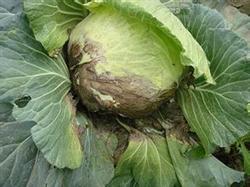
This spring has seen more low-temperature and low-light days, which favors the occurrence of cabbage sclerotinia rot. Vegetable growers are urged to take control measures early to reduce the damage. 1. Symptoms and characteristics: After seedlings are infected, water-soaked light brown lesions appear on the leaves, with indistinct edges, and the diseased tissue soft-rots, causing damping-off. When plants are infected during the head-forming stage, on the stem bases near the ground...
 Rencheng District, Jining City, Shandong Province, China is the home of stevia in China. In recent years, we have vigorously promoted the harmless cultivation technology of early spring potato-stevia-autumn cabbage, which not only reduces the market risk brought by growing stevia as a single crop, but also greatly increases farmers' income. This cropping pattern generally produces 1200-1300 kg of potatoes, 300-350 kg of stevia, and 1600-1800 kg of cabbage per 667 sq m, with an output value of 5000-5500 yuan per 667 sq m and a net income of 3500-3800 yuan per 667 sq m.
1 Production conditions
Harmless agricultural product production requires no pollution sources within a 2 km radius, and the farmland atmospheric environment quality, irrigation water quality, and soil must all meet the standards for harmless agricultural product bases. At the same time, the soil should have a deep soil layer and high organic matter content.
2 Variety selection
For early spring potato, use virus-free Luyin No. 8, Holland 15, and Dongnong 303. For stevia, use Huaxian No. 1, No. 2, and No. 3, which have large leaves, high yield, strong stress resistance, and high sugar content. For autumn cabbage, use Xiaguang.
3 Cropping arrangement
Early spring potato is sown in late February and harvested in mid-to-late May. Stevia is raised as seedlings in early April and transplanted in mid-to-late May. Autumn cabbage is raised as seedlings in late July to early August, transplanted after 25 days, and harvested in October.
4 Planting specifications
Early spring potato uses ridge cultivation with wide and narrow rows: ridge spacing 1 m, ridge top width 60 cm, ridge height 15 cm, two rows per ridge, wide row 70 cm, narrow row 30 cm, plant spacing 25-30 cm, and 4200-4600 plants per 667 sq m. Stevia is planted in large and small rows: large row spacing 40-45 cm, small row spacing 30 cm, plant spacing 10-12 cm, and 16,000-18,000 plants per 667 sq m. Autumn cabbage has row spacing 40-45 cm, plant spacing 40 cm, and 3500-4000 plants per 667 sq m.
5 Field management
5.1 Early spring potato Before sowing, cut the seed potatoes into pieces and warm the seed potatoes. Cut 40-50 pieces per kg, each piece with at least one healthy eye from the middle-upper part. Warm the seed potatoes for 15-20 days, and transplant to the field once the young sprouts begin to sprout. Before transplanting, apply sufficient base fertilizer to the field, plow deeply 20-25 cm, and build ridges according to the specifications. After sowing, spray the herbicide Dual, then cover with plastic film. After complete emergence, release the seedlings and water. At the rosette stage, water and apply 15 kg of urea. Water 15-20 days before harvest, and pay attention to pest and disease control during the growing period.
5.2 Stevia Stevia is raised as seedlings in small arched sheds. The ratio of field area to seedbed area is 15-20:1, and the seedbed width is 1-1.2 m. Before sowing, apply sufficient base fertilizer. Apply more than 1500 kg of high-quality farmyard manure per 667 sq m, 20 kg of diammonium phosphate or 50-60 kg of ordinary calcium superphosphate, spread concentratedly on the seedbed surface, then rake level. Sow finely. Before sowing, soak the seeds for 2-4 hours, mix with fine sandy soil, and spread evenly on the seedbed. Then press lightly with a wooden board wrapped in plastic film and cover with fine sandy soil, preferably with the seeds half exposed and half buried. Remove the film 4-5 days before transplanting to harden the seedlings. In the field, apply as much farmyard manure as possible (rotted chicken manure is better), applying more than 1500 kg of farmyard manure per 667 sq m. Apply 50 kg of Saccharin compound fertilizer (15:15:15) (or 30 kg of urea and 20-25 kg of diammonium phosphate). After transplanting, check and fill in missing plants in time; cultivate 2-3 times before row closure, and pinch off the growing tips when the plants have 7-9 true leaves. After the seedlings recover, apply 30 kg of Saccharin and 20 kg of kel; before row closure, apply another 30 kg of Saccharin. During the growing period, water in time during drought and drain during waterlogging. At the same time, carry out pest and disease control well, and pick the old leaves at the lower part of the plants in time after row closure.
5.3 Autumn cabbage Raise seedlings from late July to early August, and transplant to the field after 25-30 days. Before transplanting, apply 2000-3000 kg of high-quality barnyard manure, 10-15 kg of urea, and 20 kg of diammonium phosphate per 667 sq m. Transplant with row spacing 40-45 cm and plant spacing 40 cm, setting 3500-4000 plants per 667 sq m. Water after planting, and water afterward during drought. At the head-forming stage, apply 20-30 kg of urea per 667 sq m. In late October, harvest and market in a timely manner according to market conditions and cabbage growth.