Control Methods and Technical Key Points for the Cabbage Moth
The cabbage moth, also known as the cabbage cutworm and vegetable armyworm, has the Latin scientific name Mamestra brassicae Linnaeus and belongs to the order Lepidoptera, family Noctuidae. The cabbage moth has an extremely diverse diet, with known hosts reaching over 100 species across 45 families. Among vegetables, its main hosts include cabbage, cauliflower, Chinese cabbage, radish, rapeseed, solanaceous and fruiting vegetables, legumes,...
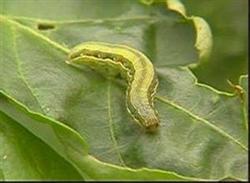
The cabbage moth, also known as the cabbage cutworm and vegetable armyworm, has the Latin scientific name Mamestra brassicae Linnaeus and belongs to the order Lepidoptera, family Noctuidae. The cabbage moth has an extremely diverse diet, with known hosts reaching over 100 species across 45 families. Among vegetables, its main hosts include cabbage, cauliflower, Chinese cabbage, radish, rapeseed, solanaceous and fruiting vegetables, legumes, cucurbits, potato, and others.
Damage characteristics: Newly hatched larvae gather on the underside of leaves, gnawing the leaf mesophyll and leaving only the upper epidermis. At the 2nd to 3rd instar they disperse and cause damage, eating holes through the leaves. After the 4th instar, they emerge at night to feed voraciously, leaving only leaf veins and petioles. Older larvae can completely consume crops and migrate in groups to damage neighboring fields. Older larvae have boring habits, often boring into leaf heads or hearts of cabbage, excreting frass, and can induce soft rot causing decay, rendering the vegetables unmarketable.
Morphological characteristics: Adult: Body length 18-25 mm, wingspan 45-50 mm. Grayish brown. Forewings have grayish-black ring-shaped markings and grayish-white kidney-shaped markings. Near the distal end of the costal margin there are 3 small white dots. The subterminal line is white and fine, with a row of black dots along the outer margin. Hindwings are gray with no markings.
Egg: Hemispherical, base diameter 0.6-0.7 mm, surface with radial three-order longitudinal ridges, with transverse partitions between the ridges. Newly laid eggs are yellowish-white, turning purplish-black before hatching.
Larva: Final instar larva body length 29.1 mm. Newly hatched larvae are blackish-green, later varying in body color from pale green to dark brown. Body segments are distinct. The dorsal line and subdorsal line appear as fine lines of white dots. The spiracular line and subspiracular line form a grayish-white broad band. On each side of each body segment on the dorsum there are black stripe markings forming an inverted figure-eight shape. The 1st and 2nd instar larvae lack the first 2 pairs of prolegs, moving like inchworms.
Pupa: About 20 mm long, reddish-brown or dark brown, with 1 dark longitudinal band in the center of the back. The anal spine is relatively long, with 2 long spines, the spine tips being spherical.
Life habits: The cabbage moth has 1 generation per year in Tibet, 1-2 generations in Gansu (Jiuquan), 2 generations in the Northeast and Northwest, 2-3 generations in Liaoning (Xingcheng), North China, Central China, and East China, and 3-4 generations in Sichuan (Chongqing), Hunan, and Shaanxi (Jinghui). In all regions it overwinters as pupae in diapause in the soil. Overwintering pupae are mostly in the host plant fields, field-edge weeds, or under field ridges. In spring of the following year from March to June, when the temperature rises to 15-16 degreesC, adults emerge from the soil. Emergence is mostly irregular, with a long emergence period. Adults hide by day and emerge at night, with activity peaking in the first half of the night. Adults have chemotaxis, with a strong attraction to molasses, but weak phototaxis. Female moths have greater phototaxis than males. Female moths mate once in their lifetime. Eggs are mostly laid on vigorously growing plants with dark green leaves. Eggs are laid in single-layer masses on the underside of middle and lower leaves, with 60-150 eggs per mass. Generally, female moths live 5-10 days and lay 500-1000 eggs, with a maximum of 3000 eggs. The suitable temperature for egg development is 23.5-26.5 degreesC, with a duration of 4-5 days. After the 3rd instar they disperse and cause damage, eating leaves into holes. After the 4th instar, they hide during the day on the underside of leaves, in leaf hearts, or in the surface soil near host roots, emerging at night to feed, but when plant density is high, they do not hide during the day. After the 3rd instar they bore into cabbage and Chinese cabbage leaf heads to cause damage. After the 4th instar food consumption increases, with the 6th instar having the largest appetite, accounting for 80% of total food consumption, causing the most severe damage. The optimal temperature for larval development is 20-24.5 degreesC, with a duration of 20-30 days. After larvae mature, they burrow into the top 6-10 cm of soil to make earthen cocoons and pupate. The pupal stage is generally 10 days, about 2 months for summer aestivation pupae, and over half a year for overwintering pupae. The cabbage moth prefers warm and relatively humid climates. A daily average temperature of 18-25 degreesC and relative humidity of 70%-80% are favorable for growth and development. Temperatures below 15 degreesC or above 30 degreesC, and humidity below 65% or above 85%, are unfavorable for its occurrence. The cabbage moth is an intermittent, locally outbreak-prone pest, often causing disasters in spring and autumn within a year.
Natural enemies of the cabbage moth: Egg parasitoids include Trichogramma dendrolimi, Trichogramma confusum, and others; larval-stage parasitoids include Campoletis chlorideae, Meteorus pulchricornis, Copidosoma floridanum, and others; pupal-stage parasitoids include Brachymeria lasus and others. Predatory natural enemies such as ground beetles, tiger beetles, ants, wasps, and spiders also play a significant role during the larval stage. According to surveys in Chongqing, ground beetles and Entomophthora are among the main factors suppressing the second-generation larvae.
Control methods
1. Agricultural control: After harvesting the vegetable field, carry out autumn plowing or winter deep plowing. Removing weeds can eliminate some overwintering pupae. Combined with farming operations, promptly remove egg masses and leaves where newly hatched larvae gather, and dispose of them centrally.
2. Trapping and killing adults: Utilizing the phototaxis and chemotaxis of adults, set up blacklight lamps or sugar-vinegar basins during the emergence period (the ratio of sugar, vinegar, wine, and water in the lure liquid is 10:1:1:8 or 6:3:1:10).
3. Biological control: First, before the larvae reach the 3rd instar, apply bacterial insecticides such as Bacillus thuringiensis: Bt suspension concentrate and Bt wettable powder, generally containing 10 billion spores per gram, diluted 500-1000 times with water for spraying. Spraying on sunny days with temperatures above 20 degreesC gives better results. Second, artificially release Trichogramma during the egg stage, setting up 6-8 points per 667 sq m, releasing 2000-3000 individuals per point each time, once every 5 days, for 2-3 consecutive times.
4. Chemical control: Seize the favorable opportunity before the 3rd instar when larvae are relatively concentrated, food consumption is low, and resistance is weak, to carry out chemical control. For commonly used pesticides and dosages, refer to those for the cabbage white butterfly. Pesticide types can also include Chujin at 2000 times dilution and Anda at 2500-3000 times dilution. If the 1st and 2nd instar larvae are missed, Meiman at 2000 times dilution can be used for spray control. To prevent the development of resistance, pesticides should be used alternately. There is no need to mix multiple pesticides or use a single pesticide variety continuously. When applying pesticides, the water volume must be sufficient, and spraying should be uniform and thorough.