Occurrence Characteristics of Pests and Diseases in High-Mountain Water Bamboo and Integrated Control Techniques
The key points of off-season cultivation techniques for double-cropping water bamboo at low altitudes are introduced as follows: 1. Selection of improved varieties. The Zhejiang Yidianhong water bamboo (a single-cropping type) is selected. 2. Land preparation and seedling raising. Select a field sheltered from wind and facing the sun, with convenient irrigation and drainage and loose, fertile soil, as the seedling bed. In early November, sun-dry the seedlings until they are 60-70% dry, 1...
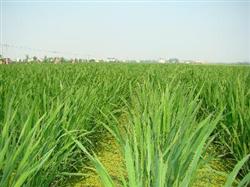 Vigorously developing high-mountain water bamboo is an important way for mountain farmers to increase their income, but in the production process, severe pest and disease damage has become a major obstacle to pollution-free production of high-mountain water bamboo. The main types of pests and diseases of high-mountain water bamboo and integrated control techniques are introduced as follows.
1. Main types of pests and diseases
(1) Water bamboo rust. Water bamboo rust mainly damages the leaves of water bamboo and also occurs on the leaf sheaths. When the disease occurs, yellow or rust-colored raised small pustules are scattered on the upper surface of the leaves and on the leaf sheaths. The pustules rupture and release rust-colored powdery material. In the later stage, gray to black small pustules appear on the leaves and leaf sheaths, elongated in shape, with the epidermis not easily rupturing. After infection, plant growth vigor weakens, and in severe cases the leaves turn yellow and wither. According to two years of observation at the Dalan trial site by our institute, the disease generally begins in late April, with peak periods in late June and early August.
(2) Water bamboo sesame spot disease. Water bamboo sesame spot disease mainly damages the leaves, and the leaf sheaths can also be affected. In the early stage of leaf disease, dense brown small spots appear, which later expand into brown spindle-shaped or elliptical spots, resembling sesame seeds. The lesions have a yellow halo around them, and in the later stage the center turns grayish-white. The lesions on leaf sheaths are larger and fewer in number. When humidity is high, dark gray to black mold-like substances grow on the lesions, namely conidiophores and conidia. In severe cases, the leaves gradually die from the tip or margin downward or inward, and finally the leaves dry up, while the leaf sheath lesions are large but few. This disease begins in early to mid-June when the average temperature is 20°C, with a peak period in mid-July.
(3) Water bamboo sheath blight. Water bamboo sheath blight mainly damages the leaf sheaths, and secondly the leaves. Initially, water-soaked dark green elliptical lesions appear on the leaf sheaths near the water surface, and later expand into cloud-like patterns. In severe cases, the leaf sheaths and leaves become soft and rot. High temperature and high humidity are the main epidemic conditions for this disease. In the field, the disease begins when the temperature is 22°C, and 25-32°C is most favorable for disease development. If continuous rainy weather occurs at this time, the disease spreads rapidly.
(4) Water bamboo stem borers. From mid-May to the end of June, the first generation of the large sugarcane borer damages water bamboo; in early to mid-June, the first generation of the striped stem borer damages it; and from late July to early August, the second generation of the striped stem borer damages it. The larvae gather at the leaf sheaths to feed, forming discolored leaf sheaths. As the larvae age, they can disperse to cause damage, boring into the heart leaves to feed, causing dead hearts.
(5) Water bamboo planthoppers. The main species is the green slender planthopper. Nymphs and adults gather near the midrib of the heart leaves and young leaves to suck sap, and the damaged areas often have white waxy powder. The damage period is generally from mid-May to late July. Planthopper damage can also induce diseases.
2. Integrated control techniques
(1) Agricultural control. First, clean up the field: before winter, burn the leftover plants and residual leaves in the field to reduce overwintering pest sources and the primary infection sources of pathogens the following year. During production, combine thinning of seedlings and removal of yellow leaves, promptly remove diseased plants and residual leaves and dispose of them centrally, and enhance field ventilation and light transmission. Second, scientific fertilizer and water management: mainly adopt technical measures such as applying sufficient base fertilizer, appropriately increasing phosphorus, potassium and zinc fertilizers, controlling the amount of nitrogen fertilizer, and draining the field at the right time and to the right degree, so that plants grow robustly and their stress resistance is enhanced. Third, when the stem borers (striped stem borer and large sugarcane borer) are about to pupate, drain the field water to lower the pupation position of the larvae, and at the peak of pupation irrigate with deep water to drown some pupae and reduce their population base. Fourth, establish intercropping and rotation systems. After continuous planting for two seasons, water bamboo fields need rotation, preferably rotation with dryland crops.
(2) Physical control. Utilizing the phototaxis of pests, use yellow sticky boards to trap and kill the green slender planthopper and aphids; use sex pheromones and insect-killing lamps such as frequency-vibration insect-killing lamps and black light lamps to trap and kill adults of the striped stem borer and large sugarcane borer.
(3) Biological control. Maintain a good ecological environment, protect and utilize natural enemies of pests, such as predatory natural enemies including spiders and frogs, and release ducks and fish in water bamboo fields to control pests and weeds.