Jiaobai (wild rice stem) is prone to Helminthosporium leaf spot disease under high-temperature and high-humidity weather
Jiaobai Helminthosporium leaf spot is a fungal disease. In recent years, as the jiaobai planting area has continued to increase, the scope of occurrence of this disease has gradually expanded, and the severity has become increasingly worse. This disease can occur throughout the entire growth period of jiaobai. It mainly damages the leaves. In the early stage, small yellow-brown spots appear on the leaves, which later expand into brown spots the size of sesame seeds, with a few forming...
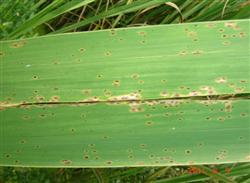
Jiaobai Helminthosporium leaf spot is a fungal disease. In recent years, as the jiaobai planting area has continued to increase, the scope of occurrence of this disease has gradually expanded, and the severity has become increasingly worse.
This disease can occur throughout the entire growth period of jiaobai. It mainly damages the leaves. In the early stage, small yellow-brown spots appear on the leaves, which later expand into brown spots the size of sesame seeds, with a few forming streaks. There is often a yellow halo around the lesions. In the later stage, the edges of the lesions are dark brown, and the centers are yellow-brown or grayish-white. In severe cases, the lesions are densely distributed, and some merge into irregular large patches. When humidity is high, dark gray to black mold-like growth appears on the surface of the lesions. When the plant is deficient in nitrogen, the lesions are smaller; when deficient in potassium, the lesions are larger and have more obvious concentric rings. When there are many lesions, a large necrotic area forms on the leaves, causing the leaves to gradually dry from the tip downward, and in the later stage often causing the leaves to die.
This disease mainly overwinters as mycelium and conidia on diseased plant debris. The pathogen infecting jiaobai requires not only a relative humidity above 92% but also water droplets. On autumn jiaobai, the initial onset period is from late June to early July. The disease develops rapidly around July 10, and the peak incidence occurs from around July 20 to early September. After mid-September, the disease slows down, and it stops developing in mid-November. Fields with acidic soil, potassium or zinc deficiency, long-term deep-water irrigation causing oxygen deficiency, and extensive management have severe disease incidence. Under high-temperature and high-humidity conditions, continuous cropping fields with high planting density, excessive nitrogen fertilizer application, and poor field ventilation and light penetration are prone to inducing this disease.
To prevent jiaobai Helminthosporium leaf spot, attention should be paid to strengthening field management. (1) Crop rotation. Rotate jiaobai with lotus root, water chestnut, arrowhead, taro, etc. (2) Stubble cutting. In winter, cut jiaobai plants at a height of 1.5 cm above the ground, and take the residual stems and leaves out of the field for centralized burning. (3) Fertilization. Apply winter fertilizer in winter, seedling-promoting fertilizer in spring, and timely spray foliar fertilizer. Use organic fertilizer as the main type, generally applying 2500-4000 kg per mu. For fields deficient in phosphorus and potassium, pay attention to supplementing phosphorus, potassium, and zinc fertilizers. (4) Water management. During the high-temperature period from July to August, maintain a water layer of 12-18 cm, and frequently change the water to lower the temperature. Pay attention to field drying. After each cultivation, dry the field until the surface soil shows some cracking before irrigating again, to improve the vitality of the jiaobai root system.
In production, chemical control of jiaobai Helminthosporium leaf spot should begin from the late tillering stage or in the early stage of disease onset. The following can be used for spraying: 25% prochloraz emulsifiable concentrate at 1500-2000 times dilution, or 40% iprobenfos wettable powder at 600-800 times dilution, or 50% iprodione wettable powder at 800-1000 times dilution, or 50% carbendazim·sulfur wettable powder at 500-600 times dilution, or Fuxing 40% flusilazole emulsifiable concentrate at 5000-6000 times dilution, etc. Apply once every 10 days, for 2-3 consecutive applications.