Detailed Explanation of the Mud-Nesting Cultivation Technique for Water Bamboo (Zizania latifolia) in Greenhouses
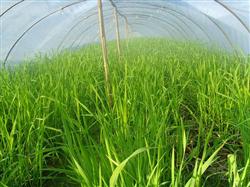
1.1 Variety: For water bamboo, the high-yield, high-quality mid-season variety Zhejiao No. 2, which is suitable for local planting, was selected. This variety was introduced from Zhejiang University in 1995 and, after years of domestication and breeding by agricultural technology departments, has become the main cultivar widely planted in Yuyao City. Zhejiao No. 2 has a plant height of about 2 m, leaf width of 3.5-4.5 cm, strong tillering, ...
1.1 Variety
For water bamboo, the high-yield, high-quality mid-season variety Zhejiao No. 2, which is suitable for local planting, was selected. This variety was introduced from Zhejiang University in 1995 and, after years of domestication and breeding by agricultural technology departments, has become the main cultivar widely planted in Yuyao City. Zhejiao No. 2 has a plant height of about 2 m, leaf width of 3.5-4.5 cm, strong tillering ability, and good stress resistance. The shoot body is spindle-shaped, the shoot flesh is 17 cm long, the transverse diameter is 4 cm, and the net shoot weight is about 90 g. The shoot flesh is white and smooth, with thin skin and a tender texture. It has high yield, concentrated harvesting, good marketability, and good economic returns, and is highly favored by water bamboo growers and the market.
1.2 Field Selection
For mud-nesting cultivation of water bamboo in greenhouses, it is advisable to choose fields that are low-lying, have fertile and loose soil, high organic matter content, a deep plow layer, convenient drainage and irrigation, good water quality, no pollution from industrial "three wastes," and that have not been continuously planted with water bamboo.
1.3 Selecting and Retaining Excellent Seedlings, Reasonable Close Planting
Water bamboo seedlings must be strictly selected every year. Choose clumps with uniform plant type, a high shoot-bearing rate, plump shoot flesh, a low shoot-setting position, no male shoots or gray shoots, low tillering nodes, and uniform maturity for seed retention. From late March to early April, dig up the seed clumps and divide the seedlings for temporary planting, 1 seedling per hole, with a temporary seedling density of 30 cm x 40 cm, and a seedling field to main field ratio of 1:10. Begin transplanting in early July, with a planting density of 100-80 cm x 50 cm, 2 plants per hole, 22,500 holes/hm2. If the leaves of the planted seedlings are too long, the upper leaves should be cut off in time to reduce nutrient consumption by the plants. For a 6 m wide greenhouse, leave 70 cm at the film edge, and plant a total of 6 rows.
1.4 Cleaning the Water Bamboo Field and Applying Sufficient Base Fertilizer
The autumn water bamboo harvest basically ends in mid-November. By mid-December, cut off the aboveground residual plants and dead leaves level with the mud, clean the field, and burn them in a centralized manner to reduce the overwintering base of insects and pathogens. For fields with many weeds, 5-6 d before building the greenhouse, drain the standing water in the water bamboo field and spray with 1 kg of 10% glyphosate aqueous solution mixed with 40 kg of water. Apply shallow water 2-3 d before building the greenhouse, and apply 120-150 kg per 667 m2 of special organic fertilizer for water bamboo (developed by the Institute of Environment, Resource, Soil and Fertilizer, Zhejiang Academy of Agricultural Sciences, produced by Cixi Zhongci Ecological Fertilizer Co., Ltd., containing 25% organic matter, 7% n, 5% p2o5, and 8% k2o) or 50 kg of Russian-produced compound fertilizer (with effective nutrient contents of nitrogen, phosphorus, and potassium each at 15%).
1.5 Building the Greenhouse for Heat Preservation and Careful Management
At the end of December, around the winter solstice, build the greenhouse and cover it with film to prevent frost. Water bamboo greenhouses mainly use bamboo-framed greenhouses. The bamboo-framed greenhouse is 6 m wide, 1.8-2.0 m high, with a central post, and its length depends on the field. Use 0.08 mm thick, 8 m wide multifunctional drip-free film. During the year, the greenhouse should mainly be kept sealed for heat preservation. After the Beginning of Spring, the temperature changes sharply, so it should still be kept sealed at night for heat preservation, and checked and observed frequently during the day. In ordinary mild weather, ventilate at both ends; when the weather is clear and the temperature inside the greenhouse exceeds 32°C, uncover the side film and ventilate at both ends for air exchange; during continuous rainy weather, ventilation should also be strengthened, which helps produce strong seedlings and reduces the shoot-bearing rate of small seedlings. Generally, remove all the film around Qingming.
1.6 Thinning and Final Singling of Seedlings, Skillful Application of Topdressing
At the end of February and beginning of March, the temperature begins to rise, and the water bamboo plants grow rapidly. When the plant height is 30-40 cm, thin the seedlings inside the greenhouse, leaving about 200,000 strong seedlings per clump, so that the effective seedlings per 667 m2 can reach about 30,000. When thinning seedlings, combine with field cultivation and weeding, remove weeds along the field edges, and improve soil aeration. At the same time as field cultivation, press mud around the root zone of the water bamboo clumps to earth up the roots, so that the tillers spread out and the nutritional status is improved. On the premise of good thinning, apply strong-stem fertilizer in time according to seedling color, generally 25-30 kg per 667 m2 of imported compound fertilizer. At the end of March, the water bamboo gradually flattens its stems and begins to form shoots. When 30% of the plants have formed shoots, apply shoot-forming fertilizer as appropriate according to leaf color, with 5-6 kg per 667 m2 of urea, to ensure the nutrients needed after shoot formation and ensure that the shoot flesh is plump and white.
1.7 Mud Nesting to Protect the Shoots and Timely Harvesting
At the end of March and beginning of April, the water bamboo has already begun to form shoots one after another. At this time, it is necessary to harvest and manually nest mud to protect the shoots. The purpose of mud nesting is to block direct sunlight on the water bamboo, raise soil temperature, promote thick, white, and crisp-tender water bamboo, and increase the marketable rate. Mud nesting should be done in stages. For each clump, once 1 plant is seen to have formed a shoot, nest mud around that 1 plant, and as the water bamboo continues to elongate, continue nesting mud. Generally, the mud-nesting height is 5-20 cm and must not exceed the water bamboo eye. Because plants form shoots at different times, it is necessary to harvest while nesting mud to promote the enlargement of individual water bamboo shoots. When the water bamboo grows until the central leaf contracts, the leaf cushions on the left and right sides contract to the same level, and the middle swells to the point of slightly exposing the heart, harvest in time.