Scientific prevention and control methods for cotton Fusarium wilt and Verticillium wilt
Cotton Fusarium wilt and Verticillium wilt are the main diseases affecting high yield and high efficiency of cotton. Only by correctly identifying the symptoms and taking corresponding measures can yield and quality be improved and benefits increased. I. Cotton Fusarium wilt: This disease can occur at the cotyledon stage, with the first peak of incidence appearing at the squaring stage. At the seedling stage, the symptoms of Fusarium wilt are complex and varied...
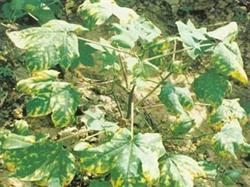
Cotton Fusarium wilt and Verticillium wilt are the main diseases affecting high yield and high efficiency of cotton. Only by correctly identifying the symptoms and taking corresponding measures can yield and quality be improved and benefits increased.
I. Cotton Fusarium wilt: This disease can occur at the cotyledon stage, with the first peak of incidence appearing at the squaring stage. At the seedling stage, the symptoms of Fusarium wilt are complex and varied, and can be roughly divided into four types.
1. Yellow vein-net type. The veins of the cotyledons or true leaves of the seedlings fade green and turn yellow, while the leaf mesophyll remains green; part or all of the leaf forms a yellow net-like pattern, and finally the leaf wilts and drops off.
2. Yellowing type. The cotyledons or true leaves turn yellow, and sometimes localized necrotic spots form along the leaf margins.
3. Purple-red type. The cotyledons or true leaves turn purplish red or purplish red spots appear.
4. Green wilt type. The cotyledons or true leaves suddenly lose water, the color turns slightly dark green, and the leaves wilt and the plant collapses and dies; sometimes the whole plant wilts while still green, and sometimes one side wilts. The appearance of each type varies with environmental changes. Generally, under conditions suitable for disease development, especially under greenhouse inoculation, most cases are of the yellow vein-net type; when the climate changes drastically, such as rapid clearing after rain, the green wilt type occurs more often. The typical symptom of Fusarium wilt at the cotton squaring stage is the stunted type. The diseased plants are characterized by a short plant type; the internodes of the main stem and fruiting branches are significantly shortened and bent by the pathogen, the leaves are dark green, wrinkled and uneven, thicker than normal leaves, with leaf margins slightly curled downward; sometimes individual leaves in the middle and lower parts have part or all of their veins turn yellow in a net-like pattern, and the vascular bundles at the affected site also turn brown. Fusarium wilt can be transmitted through infected seeds, diseased soil, diseased plant residues and cake fertilizer. www.8658.cn Balu Entrepreneurship Network
II. Verticillium wilt: Under natural conditions, after cotton is infected with Verticillium wilt, symptoms gradually appear at the squaring stage. Generally, incidence reaches its peak during the flowering and boll-setting period in July-August. The symptoms are that the diseased plant starts showing disease from the lower leaves and gradually develops upward; the edges of the diseased leaves curl slightly upward, and light yellow irregular patches appear between the veins, commonly known as "watermelon rind leaf", and even the entire leaf scorches and drops off, leaving bare stems. Sometimes adventitious buds and branches and leaves emerge at the base of the diseased plant or in the leaf axils where leaves have fallen.
III. Prevention and control measures
1. Select disease-resistant varieties. Disease-resistant varieties are the most direct and effective method for controlling Fusarium wilt and Verticillium wilt. Varieties promoted by the national agricultural technology extension departments can be selected.
2. Soil testing and formulated fertilization. Control the amount of fertilizer applied according to soil nutrient content and the growth pattern of cotton; apply organic fertilizer and rationally apply major elements such as nitrogen, phosphorus and potassium as well as medium and trace element fertilizers such as boron, so as to reduce crop nutrient deficiency disorders, antagonistic syndromes, Fusarium wilt, Verticillium wilt and other pests and diseases, as well as fertilizer damage caused by excessive fertilization. From the seedling stage to the squaring stage, apply less quick-acting nitrogen fertilizer and more slow-release calcium magnesium phosphate potassium fertilizer and organic matter fertilizer, accounting for about 10%-15% of the total fertilization amount; from squaring to the flowering stage, apply nitrogen, phosphorus and potassium fertilizers lightly and steadily, accounting for about 15%-20% of the total fertilization amount; from flowering to the boll-setting stage, apply nitrogen, phosphorus and potassium fertilizers and organic matter fertilizer heavily, accounting for about 60% of the total fertilization amount; from boll setting to the boll-opening stage, supplement nitrogen fertilizer or cotton-specific compound fertilizer according to local conditions.
3. Implement crop rotation and changing stubble. This method is an effective way to prevent and control Fusarium wilt and Verticillium wilt, avoiding the favorable living environment for pathogenic organisms brought by continuous cropping.
4. Use targeted medication for treatment. To prevent and control Verticillium wilt and Fusarium wilt, use 10-15 g of 300-500 times JiaK? fungicide spirit, mixed with 40 g of "Luoxiaowang" foliar nutrient solution, and spray the entire initially diseased cotton field; at the same time, use 20 g of 600-700 times 80% hymexazol? fu, namely "Lüxiang", plus 20 g of "JiDongLi" multi-element foliar fertilizer solution to drip-irrigate directly at the roots. In addition, attention should also be paid to timely sowing and timely removal of diseased plants in the cotton field.