Occurrence and Integrated Control Methods of Water Bamboo Smut
Water bamboo smut is a major disease of water bamboo (Zizania latifolia), mainly affecting the leaf sheaths and the edible swollen stems, leading to reduced yield and quality of water bamboo. The main symptoms and integrated control methods of this disease are briefly described below: 1. Main symptoms: In the early stage of leaf sheath infection, the lesions appear as small dark green round spots, which later develop into oval tumor-like protrusions; in the later stage, the leaf sheaths are filled with black spore masses, causing the leaf sheaths to turn black. When the edible swollen stem is infected, the smut fungus fills the water bamboo tissue, causing the middle to swell and protrude, the edible stem strips to become shorter, and the outer surface to have many longitudinal grooves. It becomes rough, and in severe cases the edible stem is unfit for consumption.
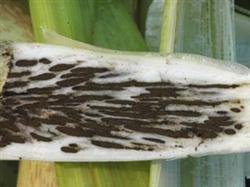
Water bamboo smut is a major disease of water bamboo, mainly affecting the leaf sheaths and the edible swollen stems, leading to reduced yield and quality of water bamboo. The main symptoms and integrated control methods of this disease are briefly described below:
I. Main symptoms: In the early stage of leaf sheath infection, the lesions appear as small dark green round spots, which later develop into oval tumor-like protrusions; in the later stage, the leaf sheaths are filled with black spore masses, causing the leaf sheaths to turn black. When the edible swollen stem is infected, the smut fungus fills the water bamboo tissue, causing the middle to swell and protrude, the edible stem strips to become shorter, and the outer surface to have many longitudinal grooves. It becomes rough, and in severe cases the edible stem is unfit for consumption.
II. Integrated Control Methods
1. Crop rotation Fields where water bamboo smut has occurred should be rotated with upland crops on an alternate-year basis. This can effectively control the occurrence of the disease.
2. Selection and retention of sterile seed plants Retain seed in disease-free fields, and consistently select robust, fungus-free, high-quality water bamboo shoots for seedling propagation and planting.
3. Seedling treatment In spring, cut off the aboveground parts of old seedling clumps and lower the clumps to reduce the tillering node position. If the introduced seedlings are suspect and unreliable, use a 600-fold solution of 25% carbendazim wettable powder and 75% chlorothalonil wettable powder (1:1) to soak the base for disinfection, so as to eliminate the pathogen carried by the seedlings.
4. Thinning of excessively dense tillers At the early stage of sprouting of old water bamboo clumps, thin out excessively dense tillers so that nutrients are concentrated, sprouts and tillers emerge uniformly, field water layer management is facilitated, and the probability of disease occurrence is reduced.
5. Strengthening fertilizer and water management Apply sufficient decomposed organic fertilizer or 100 kg of Zhengfeng ecological granular fertilizer per 667 sq m (1 mu) as base fertilizer. According to experiments, applying Zhengfeng ecological fertilizer results in less disease occurrence than applying nitrogen, phosphorus, and potassium ternary compound fertilizer, and has a longer duration of effect. Adhere to scientific irrigation and manage the water layer according to different growth stages, avoiding long-term deep flooding. That is, according to the needs of promoting the tillering stage, suppressing the late tillering stage, and promoting the swollen stem formation stage, maintain a shallow water layer of 3-5 cm in the early tillering stage, and combine with heavy topdressing, applying 30 kg of ternary compound fertilizer per 667 sq m to strongly promote tiller growth; during the high-temperature and high-humidity period, control topdressing to prevent excessive growth, and irrigate deeply to suppress ineffective late tillers; during the swollen stem formation stage, keep the water bamboo field moist.
6. Manual removal of diseased leaves In conjunction with farming operations such as intertillage and topdressing, promptly remove lower yellow leaves and diseased leaves, and carry them out of the field for destruction, so as to enhance aeration and light penetration.
7. Chemical control Spray pesticide as early as possible at the initial stage of disease occurrence. The following agents can be used alternately: 3% polyoxin wettable powder 600-fold solution, or 1:1.5:250 Bordeaux mixture, or 25% triadimefon wettable powder 1000-fold solution (pre-harvest interval 3 days), or 25% carbendazim wettable powder and 75% chlorothalonil wettable powder (1:1) 600-fold solution (pre-harvest interval 7 days), spraying once every 7 days for 3-4 consecutive treatments. If applying pesticide during the rainy season, pay attention to timely re-spraying after rain.