Symptom Identification and Control Methods of Rice Blast Leaf Spot on Water Bamboo
Rice blast leaf spot is a major disease of water bamboo, widely distributed and commonly occurring, found in all water bamboo growing areas, with more severe incidence in summer and autumn, diseased plants often reaching 80%-100%, significantly affecting water bamboo production. [Symptoms] This disease mainly affects the leaves. The lesions initially appear as small brown necrotic spots, which later develop into nearly oval to spindle-shaped...
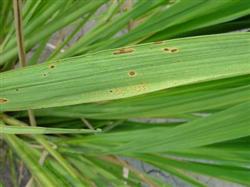
Rice blast leaf spot is a major disease of water bamboo, widely distributed and commonly occurring, found in all water bamboo growing areas, with more severe incidence in summer and autumn, diseased plants often reaching 80%-100%, significantly affecting water bamboo production.
[Symptoms] This disease mainly affects the leaves. The lesions initially appear as small brown necrotic spots, which later develop into nearly oval to spindle-shaped yellowish-brown small necrotic lesions. The center of older lesions is slightly lighter in color, and the margins often have a yellow halo. When humidity is high, the lesion surface produces dark gray to black mold-like growth, which is the pathogen's conidiophores and conidia. When the disease is severe, the lesions are densely distributed and interconnect to form irregular large spots, eventually causing the diseased leaves to wither and die.
[Disease Development] The pathogen overwinters as mycelium and conidia on old plants or diseased plant residues. When conditions are suitable, it produces conidia for primary infection. After the disease occurs, the infected parts produce conidia that spread through airflow or rain splashing for secondary infection, causing the disease to expand and spread. High temperature and high humidity are favorable for disease development. The pathogen's growth temperature range is 5-35°C, with an optimum temperature of 28°C. The optimum temperature for conidial germination is 28°C, requiring high humidity conditions; saturated humidity or water droplets or water films are more favorable for germination. The pathogen has strong stress resistance and can survive for several years under dry conditions. Usually, during the water bamboo growing period, high temperature and frequent rain, or hot and humid conditions, result in more severe disease occurrence. In addition, long-term continuous cropping, potassium and zinc deficiency in the field, and poor plant growth all favor disease development.
[Control Methods]
1. Combined with cutting stubble before winter, thoroughly clean up diseased and old leaves, centrally crush and compost them to reduce field inoculum sources.
2. Strengthen water and fertilizer management. Apply winter fertilizer in winter and sprouting fertilizer in spring. In areas where the disease frequently occurs, pay attention to increasing phosphorus, potassium and zinc fertilizer application, drain and dry the field at appropriate times and to an appropriate degree to promote root growth and enhance plant disease resistance.
3. Carry out chemical control at the early stage of disease onset. Options include 50% Dimethirimol wettable powder at 500 times dilution, or 40% Fuxing emulsifiable concentrate at 5000 times dilution, or 40% Iprobenfos wettable powder at 600 times dilution, or 2% Kasumin aqueous solution at 400 times dilution, or 70% Thiophanate-methyl wettable powder at 600 times dilution, or 30% Beisheng emulsifiable concentrate at 1500-2000 times dilution for spraying, applying 1500-1800 kg of spray solution per hectare, with one treatment every 7-15 days, and 2-4 treatments depending on disease severity.