Detailed Explanation of Key Technical Points for Field Management of Water Bamboo
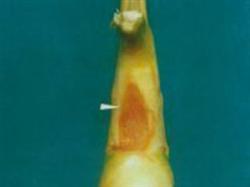
[Symptom characteristics] Water bamboo soft rot mainly occurs in the water bamboo shoots during transportation, sales and storage after harvest. Infected water bamboo shoots initially show nearly round to irregular, nearly translucent water-soaked spots, after which the lesions spread rapidly, the affected tissue softens and rots, and a foul odor is noticeable, ultimately causing part or most of the tissue of the water bamboo shoot to rot so that it is inedible. Affected...
 1. Rational fertilization. Because water bamboo has a long growth period, tall plants and a relatively high nutrient requirement, it is a fertilizer-tolerant crop, requiring sufficient base fertilizer and timely topdressing. Base fertilizer: apply 35-40 loads of human and livestock manure per mu (same below), or 50 kg of ammonium bicarbonate plus 40 kg of calcium superphosphate, mix well and apply deeply by raking in combination with land preparation. Topdressing: apply a "seedling-promoting fertilizer" once 10-15 days after planting, applying 8-10 loads of human urine and manure or 25 kg of ammonium bicarbonate plus 10 kg of calcium superphosphate, but note that when applying ammonium bicarbonate it should be broadcast on a cloudy afternoon about 0.2 cm away from the water bamboo seedlings to prevent burning the seedlings; apply another "tillering fertilizer" one month after planting, applying 20-25 loads of human urine and manure or 10-15 kg of urea to promote early tillering and early shooting, and apply another "shoot-bearing fertilizer" at the end of July. For this fertilization, the timing must be grasped well; applying too early makes the plants grow excessively vegetatively, while applying too late affects shoot formation. Generally, apply it when 80% of the plants in the field have tillers that are flat in shape and swelling can be seen. Apply 30-35 loads of human urine and manure per mu or 15 kg of urea.
2. Scientific irrigation. The irrigation depth should be determined according to the different growth stages of water bamboo. After planting water bamboo, use 0.3 cm of shallow water to promote survival. As the water bamboo seedlings grow, gradually deepen the water layer. Before tillering, maintain 0.5-0.7 cm of water; in the late tillering stage, maintain 1-1.3 cm of water to control ineffective tillering; at the shoot-bearing stage, deepen it to 1.7-2 cm to promote white, plump and tender shoot flesh.
3. Cultivation and leaf stripping. From planting to row closure, carry out two cultivations and weedings and one leaf stripping. Leaf stripping mainly means removing old leaves, yellow leaves and diseased leaves from the plants. Cultivation and weeding are carried out half a month after planting and before row closure respectively, in order to loosen the soil and eliminate weeds.
4. Pest and disease control. Water bamboo mainly has one disease and three pests: leaf rust, water bamboo stem borer, aphids and white wax cicada. In June-July, due to high temperature and high humidity, plus tall plants and dense leaves, leaf rust is likely to occur. Generally, per mu, spray with 0.1-0.2 degrees Baume lime sulfur mixture + 800-fold New High Lipid Film solution, or 0.5% sodium dichlorophenate + 800-fold New High Lipid Film solution. For water bamboo stem borer, aphids and white wax cicada, per mu spray 100 g of 80% trichlorfon + 100 g of dimethoate mixed with 75 kg of water + 800-fold New High Lipid Film solution for control.
5. Timely harvesting. The harvest standard is when the three outer leaves have fully grown, the central leaf has shortened, the shoot-bearing part has swollen, the leaf sheaths have separated from being clasped together, and the white water bamboo flesh is exposed; then it can be harvested and marketed. After the first harvest, be careful during harvesting not to step on and injure nearby young shoots. After the first harvest, apply a quick-acting fertilizer once to promote the development and swelling of the second crop of water bamboo and increase the per-unit yield.