Identification Methods and Control Techniques for Rice Sheath Blight in Water Bamboo
[Symptom Characteristics] Water bamboo blast, also known as water bamboo gray heart disease, mainly infects the leaves. Leaf lesions fall into 3 types: acute, chronic and brown spot. Acute-type lesions are round-dot shaped, dark green, with a grayish-green mold layer (conidiophores and conidia) on the back of the lesion that is relatively obvious; their appearance is a precursor to a water bamboo blast epidemic. Chronic-type lesions are nearly spindle-shaped, ...
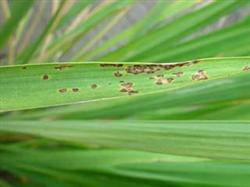 Rice sheath blight in water bamboo is a common disease, with damage tending to worsen year by year. It mainly harms the leaves and leaf sheaths, forming water-soaked, dark green to yellowish-brown cloud-patterned lesions. Under high humidity, sparse light brown mycelium grows on the diseased parts, later forming small sclerotia that are initially white and gradually turn yellowish-brown.
Occurrence characteristics: The pathogen is Rhizoctonia spp. in the subphylum Deuteromycotina. Disease onset is favored at 25-32°C combined with overcast and rainy days; continuous cropping fields have more sclerotia in the soil, and the disease is more severe.
Control methods: (1) Implement paddy-upland rotation for more than 3 years. (2) Plant at a reasonable density; combined with intertillage and other farming operations, promptly remove diseased and yellow lower leaves to improve ventilation and light penetration. (3) Apply sufficient base fertilizer, an appropriate amount of topdressing, and more phosphorus and potassium fertilizer. (4) In the early stage of disease onset, spray with 5% Jinggangmycin 1000-fold solution or 50% carbendazim 800-1000-fold solution.